
14 March 2014

08 March 2014
VENTHIR
Nation
and natural successor to the Venathi empire that dominated the northern area of
the Arid Triptych region, to the north-east of Sarastro and the north of the
Anubian desert. For the majority of its existence Venthir has been a vassal of
the Korachani empire, though it has enjoyed a degree of autonomy throughout its
occupation unlike others conquered by the Archpotentate Malichar’s armies. This
is largely due to the presence of the vastly powerful and unpredictable sphinx
regent; Hetepheres, better known as the Strangler.
The nation of Venthir appeared
as a natural progression of the earlier Venathi empire, which through the death
of its charismatic leader Labaisingh, the so-called 'lion king', in 151 RM and
the subsequent rapid loss of its conquered nations, crumbled by c. 190 RM. The Venathi capital had been ailing for decades. Its coastline, like that of all
Venath, had been slowly retreating over the centuries, leaving its ports and
harbours land-locked, its once-thriving trade dead. The ruling Asanate had never
re-established control following Labaisingh’s death, and the entire region was
allowed to degenerate into strife.
Hetepheres, her whereabouts unknown since
57 RM, returned to the city of Hetepheropolis in 194 RM. Her reappearance
helped stabilise the region, cementing her worship amongst the people of what
remained of the Venathi empire. Her religion prospered and from Hetepheropolis
a measure of law and order was restored to the region. Her armies helped secure
nearby cities over the next years, attracting disenfranchised people from all
over the empire. The Asanate, though still embroiled in its own internal
struggles for power, saw the threat and opposed her, meeting her fanatical army
in a pitched battle in the plains outside Hetepheropolis in 200 RM. Their
armies were crushed, which allowed her to sack the city, inviting its populace
into Hetepheropolis, which became the capital of Venthir (which was in the local
dialect; Venath) in 201 RM, leaving the city of Venath to crumble.
Hetepheres’ rule was harsh, though under
her aegis were order and trade restored to Venthir. The retreat of the
coastlines which had dominated the dying days of the Venathi empire became a
major rebuilding effort, with dykes and channels built to connect once-coastal
cities to the Dark Sea. Its trade-routes were re-established, and tentative
trade reappeared with Sarastro and imperial-Nárthel, where the first true
contact with Korachan was made. In the absence of the Archpotentate Malichar
the Korachani empire’s expansive nature was somewhat sated, leading to trade
and diplomatic relations. In 211 RM Korachani diplomats and Set established a
permanent embassy in the city of Midal where alchemical secrets were traded. The
city prospered, becoming a major scholastic centre once-more, its cossetted
harbours in the waters of the deep Kalaun depth largely unaffected by the
retreat of the Dark Sea’s waters. Korachani influence slowly began to permeate
Venthiri culture in the following years, reaching its crux in the city-state of
Teira, which welcomed the influx of imperial merchant-dynasties and patrician
houses (most notable amongst them that of Ashura). Their presence brought
increased trade, which allowed the city-state to grow in size, its
artificially-built canal-harbours seeing much traffic from the west.
But it became clear that Korachan’s
imperialist nature could not be contained. Zion was conquered in 212 RM and
within a decade it had declared war on Sarastro. The war was long and bloody,
the absence of the Archpotentate Malichar affecting imperial morale, but in 231
RM the city of Carula was taken. It was clear that if Sarastro was taken,
Venthir would be next.
By that point, Queen Hetepheres had
secreted herself inside lavish odah-chambers within her temple-palace in
Hetepheropolis, leaving the Asanates to rule in her stead. Following her rise
to power she had slain the most power-hungry amongst their kin, allowing those
who swore loyalty to her to languish as regional rulers who met in council
every season before her to discuss important matters. The Asanate met with her
in early 232 RM, bringing news of the war to her attention – she dismissed them
without care. As the Korachani armies continued to slowly advance across Sarastro the Asanate, alongside Hetepheres’ closest advisors secretly decided to
aid the struggling nation, and sent reinforcements west in 233 RM against the
Queen’s edict, whose languid nature allowed the move to pass unbeknownst to
her. In Sarastro, the war became deadlocked, each loss counterweighted by a
victory elsewhere. Every victory was phyrric and armies destroyed one-another
over territories that mattered not. But were it not for the presence of
Venthiri troops, Sarastro would have fallen. If they managed to push the
Korachani troops back, the Asanate believed that they maintained enough power
to assume control of the remnants of Sarastro.
In 318 RM an imperial lictor infiltrated
Hetepheres’ massive palace in Hetepheropolis and told her of the war. She
emerged from the palace enraged, slaying slaves and servants with equal
abandon, ordering the armies’ retreat from Venthir. Upon their return she
strangled the entire Asanate and their direct families, banishing their
relatives from Venthir. Her actions earned her the moniker of the Strangler
Queen, which she propagated herself in a bid to foment fear. Her tyrannical
actions served to instil awe and fear in the populace and her presence became
constant; idols and temples erected in her honour in every city, the statues
serving to remind all that she was their ruler, and her word was law. The
sphinxes telepathic abilities allowed her to maintain a vigil over her nation,
using a few trusted religious followers who had kept her religion alive in her
absence as lieutenants and proxies.
Despite the war, Korachan had maintained a
presence in Midal and Teira, both of which had steadily grown more
imperialised, to the point that their dominant institutions had become the
patrician houses, whose presence slowly trickled throughout Venthir. Teira
itself had become a major influence in the region by c. 350 RM and existed as
an entity apart from Venthir proper, a small nation unto itself. The discovery
of a potent artefact known as the Sphere of Dominion in the Go Bisammam desert
in southern Venthir by explorers from Teira in c. 300 RM brought further
influence to the region. The sphere was a large depiction of Elyden as an
uninterrupted globe, ancient beyond reckoning, its construction or heritage
unknown. The item was used in the coming centuries by Venthiri explorers to
help chart the seas east and south of Venthir, where they made contact with
indigenous peoples, establishing colonies there
With the withdrawal of Venthir from the
War, Korachan was able to take Sarastro (though only after the reappearance of
the Archpotentate Malichar in 339 RM). Imperial influence in the region
continued to increase in the ensuing decades, with Teira and Midal in
particular seeing much imperial trade and traffic passing through them.
Imperial pressure was to increase until 359 RM, where history took an
unexpected turn.
Little is known of the events that led to
Queen Hetepheres’ abdication of Venthir to Korachan, and what is known is
attributed to legend and the corruption of close to 4-millennia. It is known
that the Archpotentate Malichar, alongside a massive retinue of his loyal
followers entered Venthir early in 359 RM, a guest of Queen Hetepheres. Staying
in her palace in Hetepheropolis, accounts and records of the times state that he
and his diplomats were treated to displays of Venthiri armies on parade, and
various other forms of propaganda designed to show its might. Later on in the
year, during a tour of the nation's south, it is said that Malichar spoke with her
alone in the ruins of the ancient settlement of Maphani, sowing what are
believed to be the seeds of corruption that would take root 2-years later when
Hetepheres unceremoniously prostrated herself before him and his armies,
effectively handing Venthir over to Korachan. The monument of Symari was
constructed in honour of the occasion, its monolithic height dominating the horizon
of southern Venthir. Though it remained largely autonomous and she remained its
regent, Venthir was accountable to Khadon in Korachan. Patrician families
flowed into Venthir from the cities of Midal and Teira, and the imperial
administration was fully established in Teira in 376 RM within the monolithic
Acropolis of Caur, an edifice built in true imperial design with its grand
granite architecture contrasting with the local structures. Teira
became the centre of imperial influence in the region, though Hetepheropolis
remained its heart, where Venthiri culture survived in its most unadulterated
form. Relations with Sarastro and Nárthel were re-established, with trade
flowing steadily in-and-out of both regions.
The religion of the Sphinx was allowed to
remain though in a controlled form and as a sub-cult of the Church of the
Machine, which advocated her as a prophetess of the imperial Church from c. 380
RM, following years of religions tension. Around the same time the mystery-cult
of Khar’illæ first appeared in Venthir, brought by traders and merchants from
farther west in other imperial nations in Sammaea. Like those regions, it was
largely quelled in the coming centuries though persisted in the form of
scattered mystery-cults.
As the Korachani administration settled
into its role in Venthir and the immigration of patricians and freemen subsided
by c. 400 RM, the empire began to look to the regions’ resources for
exploitation. The mountains and scrublands of Worknah were already home to sizeable
gold-mines, though the region exploded within the next 200-years, with the city
of Kithamar appearing south of Worknah in c. 530 RM, where it became a major
processor of raw ore and umbra, the latter of which was being extracted from
the Shamal and Neyshabur in large quantities. These first centuries of
Korachani rule were harsh on the regions’ populace; many of which became little
more than work-slaves to the industries and houses of the occupying empire. In
a bid to keep the people satisfied the administration of Teira introduced
gladiatorial games to the region in 425 RM, which rapidly spread to surrounding
areas and gained massive popularity. This served to keep the masses amused and
gave the slaves something to hope for – victory in the arena could earn a slave
freedom. The games became so popular that by c. 500 RM, itinerant mercenaries from
surrounding areas migrated to Venthir with dreams of success in the arenas.
As living memory of pre-imperial Venthir
faded, the region’s culture reached a crux of amalgamation and began developing
its on distinct customs. Amongst them the Maphrans of the Church of Machine
which were effectively little more than church-owned slaves whose sole purpose
was to breed (to offset the regions’ high mortality rate); their offspring serving
the church in a myriad of ways. From these Maphrians would later evolve the
Maphrias, who fulfilled a similar role, though amongst the noble families of
Venthir, out of which would rise House Ashura.
Already powerful, House Ashura continued to
dominate trade in the region, its members eventually becoming so influential
and permeating all facets of Teiran culture (where they were based, making it
the most imperialised of Venthiri cities) that they inherited full
administrative duties in 563 RM, instating the hereditary titles of Adonis in
575 RM, after which the House became a monarchy in all but name. In
Hetepheropolis the regent Hetepheres continued to rule, her dark whimsy hanging
pall-like above the city, her people as fearful of her retribution as they were
in awe of her beauty and power. The cult of the sphinx continued to grow,
distancing itself from the Church of the Machine as much as edicts created in
378 RM allowed.
Even though the empire periodically
launched attacks north-east against Char Mâthi, cultural ties with the region
had been bred out of Venthirs’ collective memory centuries past and there was
little to no kinship felt between the two. Despite these attacks, the region
was relatively quiet despite the occasional slave uprising, though disruption
caused by the islands of Lathlos Cha in the north-west of Venthir was kept its
navy on its toes. Populated by descendants of those Asanates banished in 318
RM, the small island-nation had grown considerably in size in the ensuing
centuries, its small yet pervasive corsairs plaguing eastern Nárthel and
Venthir, as well as the Haré Shka since c. 900 RM. In 925 RM Teira began
celebrating the 500th anniversary of the introduction of the
bloodsports with a massive 3-month festival of games, which saw no less than
200 slaves freed. In truth this was a tactic to keep increasingly restless
slaves from dissenting, and it worked. The freemen left Teira, and were given
free reign to settle any unpopulated land in Venthir. They settled the ruins of
an ancient Alrasi city north-west of Teira in 928 RM, which they christened
Latuar (Lit. freedom). The city would be a constant presence in Venthiri history for millennia
to come.
The dawn of the second millennium of the
imperial calendar brought strife to Venthir. Just off the southern coast of the
Torrent of Karrock, construction was secretly competed on a temple dedicated to
the Demiurge Shibboleth. Its completion announced by a halfblooded prophetess
known as Hammoleketh, the temple had been secretly under construction for the
past millennium, her fell sorceries keeping the place hidden from mortal eyes.
Discovery of the temple brought strife to Teira, with many rival factions and
cults appearing opposing each other. Many were executed by the Church of the
Machine, with hundreds travelling east to witness the monolithic edifice and
its halfblooded priestess. Less than 2-years after this the city of Teira was
hit by a massive plague which led to the degradation of culture there. Its
population decimated, the capital survived only through the vigilance of
imperial troops and the Ashuran monarchy, which closed off its gates to the
outside world in 1002 RM. Some blamed the retreat of the coastline and the
appearance over the last centuries of an expansive wetlands and marshes which
were said to harbour disease, though the truth was never revealed. It was
around this time that the plains of Hamshen also began to die, their slow
corruption beginning a journey that would end some 2,000-years later with the
regions' desertification.
In a bid to save the region – Hamshen was a
hub of many settlements including Midal, Hetepheropolis and the rapidly growing
Myrmica – Korachan sent aid from the west in 1009 RM, in the form of alchemical
vaccines and food and other provisions. In addition great siphon
engines were constructed in Hamshen, their colossal engines sapping latent
umbra from the atmosphere and pumping it south where it could be processed for
use in other industries. Though despite these implementations, the region
continued to suffer.
Over the next centuries Venthir bore
witness to a change. Power waned in the east and waxed in the west, Midal,
Hetepheropolis and Myrmica benefitting from the siphon engines installed there.
Teira reopened its gates in 1102 RM when the last taint of plague was expunged,
though the road to recovery was to be long. In its place did the city of
Katlego rise to prominence, its technarcanist academies aiding it against the
disease-ridden lands that appeared in the wake of the retreating coastline. It
and Midal became new powers, their alchemists and technologists becoming the
new elite of Venthiri society. They rapidly overtook the patricians and House
Ashura in power, and by 1293 RM had implemented a technocracy across most of
Venthir. The imperial Minasteria of Donhim was moved to Myrmica in 1238 RM in
recognition of its advances in the art, and the twin cities of Midal and
Katlego continued to advance the state of technarcana, becoming centres of its
learning. The ruling Ashura of Teira disappeared in c, 1300 RM as the new
technocracy introduced in Midal took root.
The secular dissolution that swept across
the Korachani empire of 1393 RM stripped these technologists and their
janissary elites of much of their powers, leading to civil uprisings between
the technologists and their allies and the Church of the Machine. The conflict
lasted 9-years, ending in 1402 RM with the technologists victorious, their
patron none other than Hetepheres who saw the worth of their technarcana. She
personally oversaw the execution of their opponents, which numbered in their
thousands, their slain bodies displayed outside her palace to deter other
uprisings. The technocracy was moved to Teira, which became the new capital of
the region (the city of Hetepheropolis remained a cultural capital, with most ceremonial duties remaining there).
Seven days after the executions two
sphinxes, large and ancient beyond measure, their features resplendent in the
wisdom and truth of ages, arrived in Hetepheropolis, demanding an audience with
the queen. The sphinx-queen knew of their coming, for all sphinxes shared
dreams and consciousness and were as one. She granted them audience in her
expansive chambers, where they admonished her bloodthirsty rule, blaming her
actions for both the degradation of their species and the diminishing of culture. She attacked the two, killing
them on the spot. Their skulls and wings are said to adorn her throne to this day.
Enraged by their actions she sought out a way to sunder her thoughts from those
of her kin, for as long as they thought as one, she could not rule as she
willed.
She chose a cadre of the most skilled
technologists and employed the eldest of the alchemists of Midal and secreted
herself in her palace, seeking a means with which to sunder her dreams from
those of her kin. The technocracy of Teira ruled in her absence, bringing
industry back to Venthir. Under the leadership of the technocracy, Kithamar
grew in power and by c. 1480 had become one of the largest raw umbra processors
of the empire, its ataliers and pumping stations becoming prestigious, though
measures had to be taken against the encroaching deserts of the Go Bisammam.
Clashes with the Church of the Machine continued, though it had by then lost
much of its influence in Venthir. By c. 1450 RM it had become little more than a relic of
another time, an antiquated establishment that clung to its ancient rituals;
the only cities where it retained any influence being Midal and Merakhi. In
1453 RM technologist forces attacked pilgrims undertaking the Shadow March in
south-western Venthir, ending in their massacre. This led to the enactment of
the so-called Statute of Rights in 1455 RM, its intent to safeguard the passage
of those undertaking the pilgrimage. In honour of the events of 1453 RM, the
church constructed the Basilica of the Holy Blood over the site of the massacre
in 1474 RM, which itself became part of the Shadow March.
In 1593 RM construction was completed on a
massive technarcane engine in the heart of the palace of the Maphrias in
Hetepheropolis. The engine was an extremely complex feat of technarcana, with
only a small part visible to the outside world. Its purpose was never fully
disclosed though in the decades following its construction the taint that had
been encroaching upon the plains of Hamshen began to slowly recede, leading
most to believe it was a Siphon engine. Others maintained that the engine had a
far more sinister application, one related to the obsession that had consumed
the reclusive Hetepheres for close to 2-centuries already.
The technologists’ rule continued in
relative peace, their industry and inventions exported across the empire,
bringing much wealth into Venthir. That, coupled with mundane trade in goods
such as spices, gems and opiates made the region one of the richest in the
empire and Venthir prospered. The Nathi Road was officially reopened in 1603 RM
and relations with Sarastro reached an all-time high. This period of Venthiri
history would last for another 3-centuries before Queen Hetepheres would emerge
from her dungeons in 1905 RM.
Under the aegis of her technologist cadre,
whose numbers had swollen over the years through secretive recruitments, she
emerged from her dungeons a changed being. Where once she had been a creature
of unbridled grace and savage beauty, echoing the dichotomy of a storm, now she
was a changed thing, twisted and wretched, covered in a myriad of orthoses and
technarcane engines grafted about her. Unrecognisable save her savagery she
abolished the technocracy in Teira in 1906 RM without word and went on a savage campaign in
which her armies destroyed many manufactories and industrial structures,
appropriating all others from their private ownership, assuming full control of
them. The colleges of technarcana in Katlego – amongst the most prestigious in
the empire – were obliterated in 1921 RM, their custodian general Zaddock and his
followers exiled.
This precipitated a massed exodus of
technarcanists, biomechanists and other vocations, leading to the fall of the
technocracy of Midal. The few that remained in Venthir were sworn under
Hetepheres, and granted control of the remaining manufactories. Many of these
exiled technarcanists remained within Venthir, turning to an itinerant
lifestyle, wandering from settlement to settlement offering their services to
those in need. On the whole, they were
tolerated, though many regions came to despise these so-called itinerant ones. Most, however, wandered around Venthir under the
leadership of Zaddock, seeking a new home. By c. 1939 RM they settled the dry
Kautuld region in the far south-east of Venthir, out of which the small
technocracy of Saragos would later arise.
The golden-age of Venthir had ended with
the abolishment of the technocracy in Teira. Exports dwindled, its
manufactories and industries reigned back to serve its own purposes and little
else. Many regions that had been exploited for their natural resources, some
for over 2,000-years, were beginning to see the effects of mismanagement and
over-abuse. The Jaela mountains, Worknah and the Go Bisammam, were chief amongst
such places, with once-fertile grasslands rapidly dwindling into dust-filled
plains. Under the leadership of the increasingly paranoid, obsessive
Hetepheres, law broke down in smaller settlements and the nations’
infrastructure slowly crumbled. Funds were poured into large well-trained
armies that never left their borders and the study and trade of technarcana
continued to be heavily regulated, the Strangler-Queen unwilling to share the
secrets her private technologists had unearthed over the centuries. She grew
even more reclusive, spending most of her time in the ateliers beneath her
palace, consorting with technologists and their ilk, searching for new orthoses
and implants to further distance her form her kin. When she did appear it was
behind a veritable army or retainers and serfs and she spoke through proxies,
if at all.
In her negligence, Zaddock and his exiles
were allowed to grow in the south-east. By c. 2500 RM the region around the
city of Saragos had grown under the aegis of the exiled technologists, with
many settlements appearing around it, their technocracy offering a stark
contrast to the tyranny that prevailed in the north-west. Its borders had
increased, assimilating the city-state of Taarom and taking the adamantine
mines of Mount Adama in 2413 RM following 5-years of war there.
In Venthir, Korachani attempts at diplomacy
were unsuccessful and the nation continued to falter, leading to the withdrawal
of many imperial institutions over the coming centuries (with many of its
natural resources dwindling, Korachan was beginning to lose interest in Venthir,
anyway). In 2702 RM the Avénethi Fraternity, which had enjoyed a healthy
presence there for some centuries, abandoned Venthir following an earthquake.
By 2821 RM the Go Bisammam desert had grown to such a size that the city of
Kithamar was abandoned, leading to a massive decrease in umbra supplies across Venthir.
This caused the death of many manufactories and industries, most notable of
which was the silencing of its many Siphon engines, which until then had kept
the advancing penumbra at bay. Within a few decades, the entire Hamshen region
had been reduced to a deadened landscape. By 3010 RM many settlements were left
deserted, their populace migrated to the safer cities, which could afford to
maintain their own engines. Hetepheropolis, Myrmica and Teira grew
exponentially in the coming years.
The Archpotentate Malichar visited
Hetepheres personally in 3061 RM. Little is known what was spoken in the
meeting though Venthir was later granted control of much of eastern Nárthel,
its nobility gifted titles and positions within the Korachani administration,
possibly in return for the regions’ restoration. And so was industry returned
to Venthir and new mines funded, though technarcane research remained resticted. Its ports were re-established and foreign trade prospered.
In 3147 RM it was discovered that the city
of Katlego was secretly conducting its own technarcane research, under the
leadership of its Maphran Walada. Later in the year Queen Hetepheres descended
upon the city with a might army and destroyed it, slaying innocents and
technologists in their tens of thousands. Their bodies were burnt atop a great
pyre, the pillar of smoke seen for miles around. The place remains ruined to
this day, testament to the fate of those who would attract the
Strangler-Queen’s wrath.
Though the outcome of the bloody conflict
was to her expectation, Hetepheres had not left her dungeons in centuries. Her
obsession with sundering her thoughts and dreams from the remnants of her
race had been successful centuries earlier) and
she had done little to honour Malichar’s requests for a renewed glory in the
east of his empire. The gold mines of Worknah, though still viable and
providing the bulk of the nations’ wealth, were consuming slaves at an alarming
rate. Something had to be done. Starting in 3151 RM the nations’ infrastructure
was improved, roads repaired, its massive technologically-advanced armies put
to use securing its borders and trade-routes and sent abroad in what became
known as the Egret Crusades – an effort to secure a new supply of slaves.
Mirroring the actions of its ancestral nation of Nath, these crusades began in
c. 3250 RM, and lasted until 3525 RM, when the last crusade ended. These
campaigns managed to secure new territories (largely in the islands of the
Broken Lands) and a steady stream of slaves – largely from nations to the
south-west of Venthir; most notably the Growing Mountains, though Ehbot and Char
Mâthi were also targeted.
This increase in trade and slaves brought
new prosperity to Venthir and a renewed pride in its people, not least of all
its ruler. Its armies’ morale high from their many victories, they began
pushing its borders outwards. The death of Zaddock in 2383 had left Saragos
unstable, and Venthir turned to it in 3405 RM, though the conflict was short
and marred by Venthiri defeats – their foe had fortified its lands well and had
amassed a technologically superior army which, though numerically inferior, had
prepared for the expected conflict well. By 3408 hostilities had ended and the
Venthiri armies looked elsewhere, turning to Tarati, which was conquered in
3421 RM. This secured more trade for Venthir, and its armies grew more
confident, with conflict along its western borders increasingly common over the
next years. The subsequent years were more stable for Venthir, which enjoyed
the spoils of its victories even as the gold mines in Worknah were finally
abandoned in 3705 RM, the same year the Korachani empire fragmented in two.
The following years saw much tension between the northern Empire, based around Korachan in Llachatul, and the southern empire, based around Sarastro and expanding across north-western Sammaea. Venthir existed as the only significant Korachani territory in Sammaea and clashes between Sarastro and Venthir dominated the centuries following the sundering of the empire.
In 4006 RM the city of Kalchedon in
north-eastern Venthir was granted to the Avénethi Fraternity, which was
beginning a search of Firmamental artefacts in heathen lands. This was a
precursor of sorts to the War of the Shadow and the Helix, during which many
attacks were launched against Khamid and Char Mâthi from Venthir. The greatest
such battle was the Siege of the Temple of Chien Da in western Lurium, in which
Queen Hetepheres herself fought, slaying the Champion Ari.
Despite
the victories of the Venthiri armies in Char Mâthi, the death of the
Archpotentate Malichar led to the crumbling of the imperial armies, causing
their ultimate retreat and eventual defeat. But Venthir was left strong
following the War, and continued its attacks against Char Mâthi, advancing as
far north as the city-state of Lalaun by 3 RMe. By 11 RMe its efforts against
Char Mâthi had ended though, hungry for power, Hetepheres instead turned her
eyes south to Sarastro, where border clashes had become common around the
region of Hagaat, with full war engulfing the two nations by 13 RMe.
03 March 2014
World map.
I'm beginning to realise that there's a far larger emphasis placed on cartography than worldbuilding or conlanging (of which there are 0-examples thus far...). My posts are all determined by what takes my fancy at a particular time. At the moment that's the Atlas Elyden and, less-so, the Encyclopaedia Elyden. More often than not I don't work against a set schedule or time-table, as such, and just write/draw/plan whatever I feel like. Usually I tend to go overboard on one aspect for a few months before burning-out and doing nothing for a few weeks before returning to the world and developing a new aspect. So at the moment I'm in full on cartographer mode, working mostly in Photoshop, designing maps (though by necessity, the process of labelling maps means I have to update my notes to make sure that everything is on the same page so there's always a degree of writing involved when working on my maps).
Conversely, November and December were pure writing months with me concentrating mostly with my second as-yet uncompleted NaNoWriMo challenge (though I've won the challenge, i.e finished 50,000 words by the end of November, I've still a way to go... I'm expecting it be somewhere around 150-words long upon completion, possibly more, accounting for editing.
And with all these posts, I still haven't uploaded a single one to do with languages. Partially that's because I don't know anything about linguistics (or pretend to), though I do own a few books on the subject, particularly with regards to worldbuilding. Also it's because I've done very little on the subject at all. The logistics of it all worry me though...
The known history of Elyden spans some 6,000 years, with many centuries of civilised life before that leading up to a cataclysmic event from which later races evolved. languages and technologies are mostly rediscovered from the ruins of the ancient world, though in those 6,000 years many languages have evolved and branched apart from one another, leading to a dichotomy, of sorts - the historical and the modern, both of which are in use.
Make no mistake, I will touch upon language one day. But not yet :)
02 March 2014
The Man Form Earth
A little something different today. I haven’t posted
something not directly related to my worldbuilding in a while and I thought I’d
mention a film I saw a few years ago and recently revisited, which I think has
a lot to offer to worldbuilders.
The film, titled the Man From Earth (or movie, to people across the pond) has a simple
premise – what if a man could not age or die of old age? The story is brought
about quickly and concisely – a college professor is moving on from his current life and invites his friends
(professors, also) to cabin in the woods (no, not that type of Cabin in the Woods) as a sort of going away party. Their chatting evolves, quite naturally I
think, into the departing professor confessing his ‘immortality,’ and the individual
peoples’ differing reactions to his absurd story. They ask him questions about
his life and… well I won’t spoil it for those of you who have not seen it J
I am posting this here because of the theme of immortality.
To my knowledge no-one lives forever, which is one of those things that fantasy
writes often write about, so we have little real-world research to fall back
upon and I think that this film handles the subject matter wonderfully (though I
do feel the last few scenes detract from its ambiguity, if I can use the word).
How do you convincingly convey such an aspect of fantasy to
an audience who is unfamiliar with it, through a world in print in which such a
phenomenon is real? What would a man who has lived for 14,000 years remember? If
he doesn’t remember something from the 15th century will you use it
against him in a bid to disprove him, where you have no recollection of where
you were or what you were doing a year ago?
I think fellow worldbuilders will get a lot from watching
this and it might give them ideas on how to flesh out the biographies and
backgrounds of their immortal characters (hell, I know I have a lot of them
lurking in the depths of the Encyclopaedia
Elyden..)
Also, the screenplay was almost the life's work of the writer Jerome Bixby, who began conceptualising it in the early 60's and finished it on his deathbed in 1998 - almost 40 years! A true creater, much like my Demiurges, cannot stop himself!

27 February 2014
more Atlas Maps!
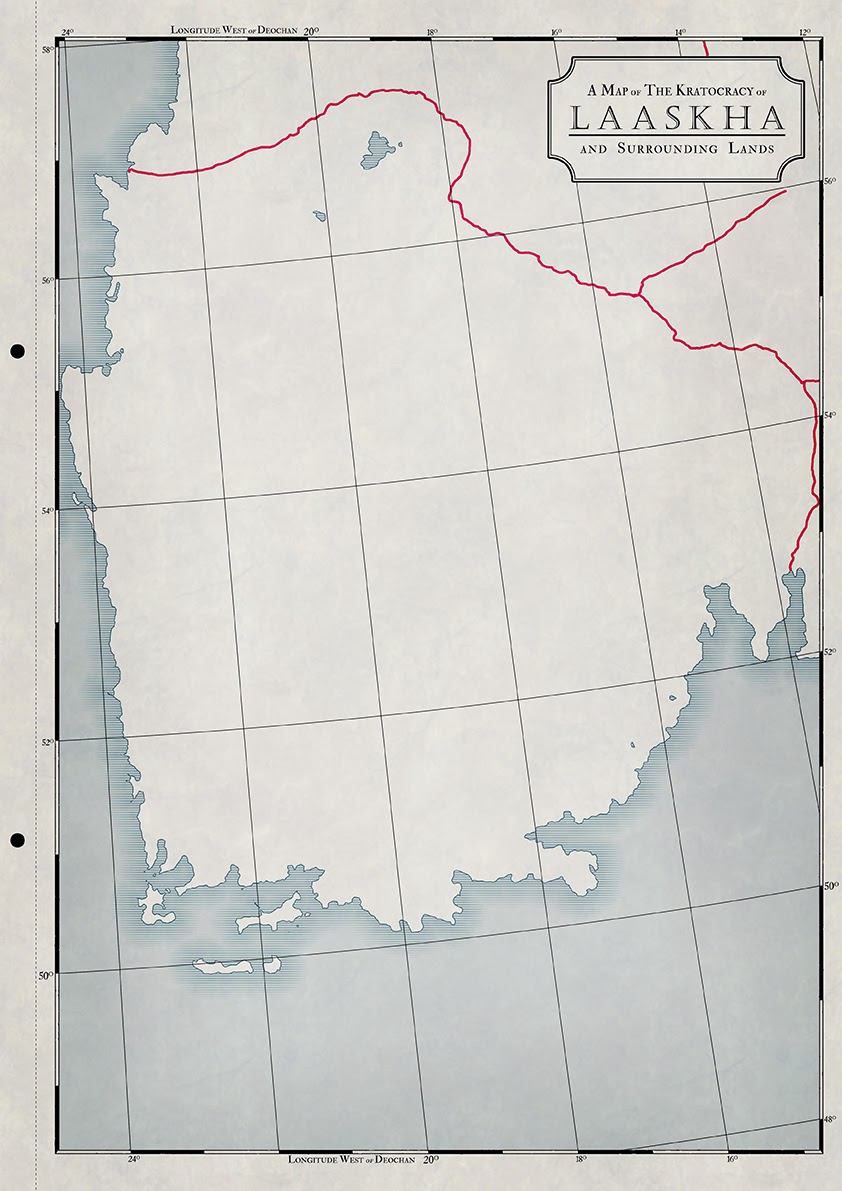
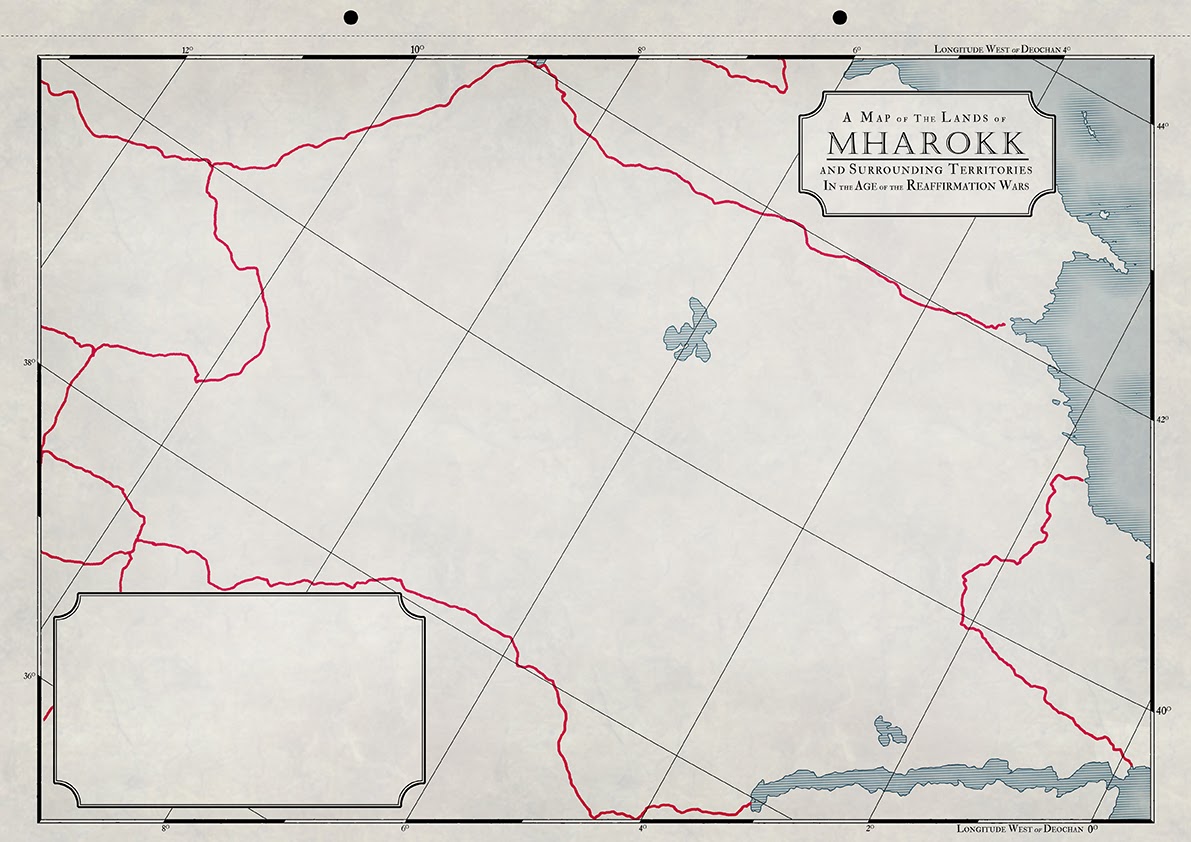
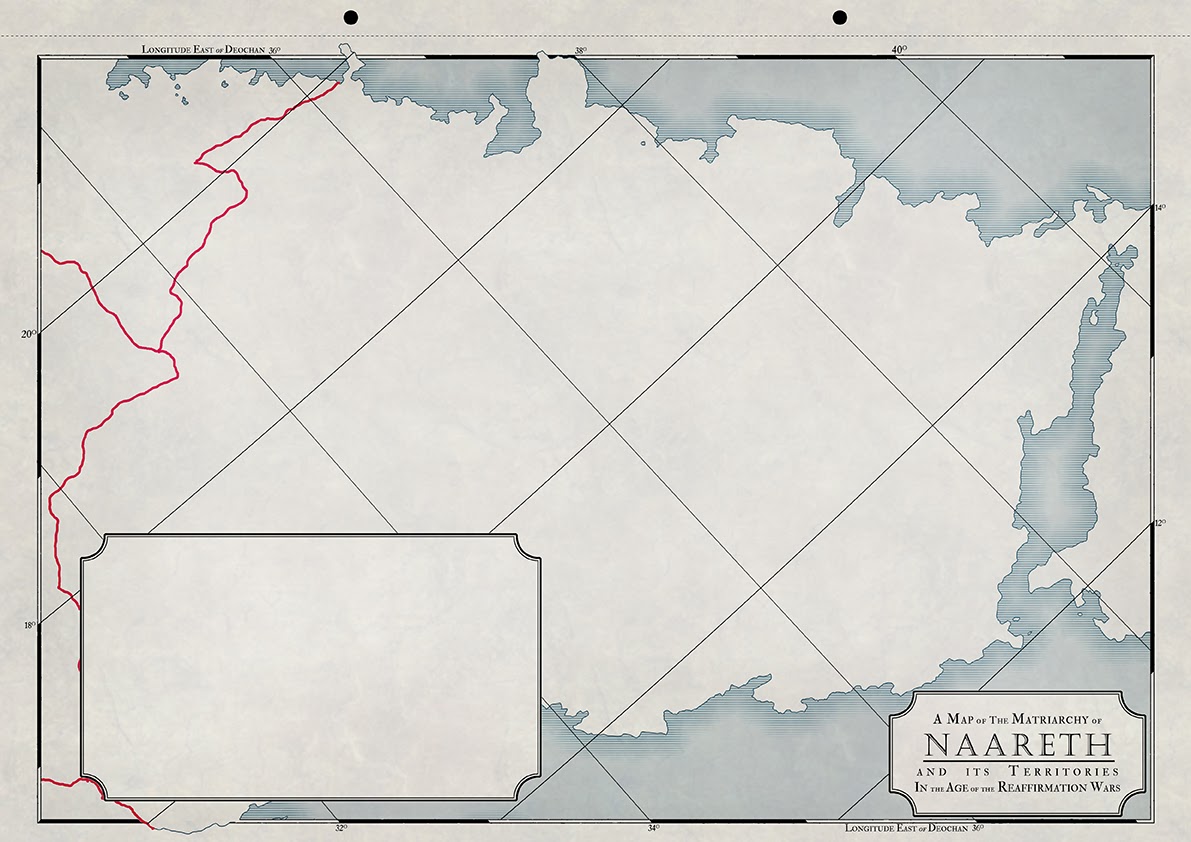
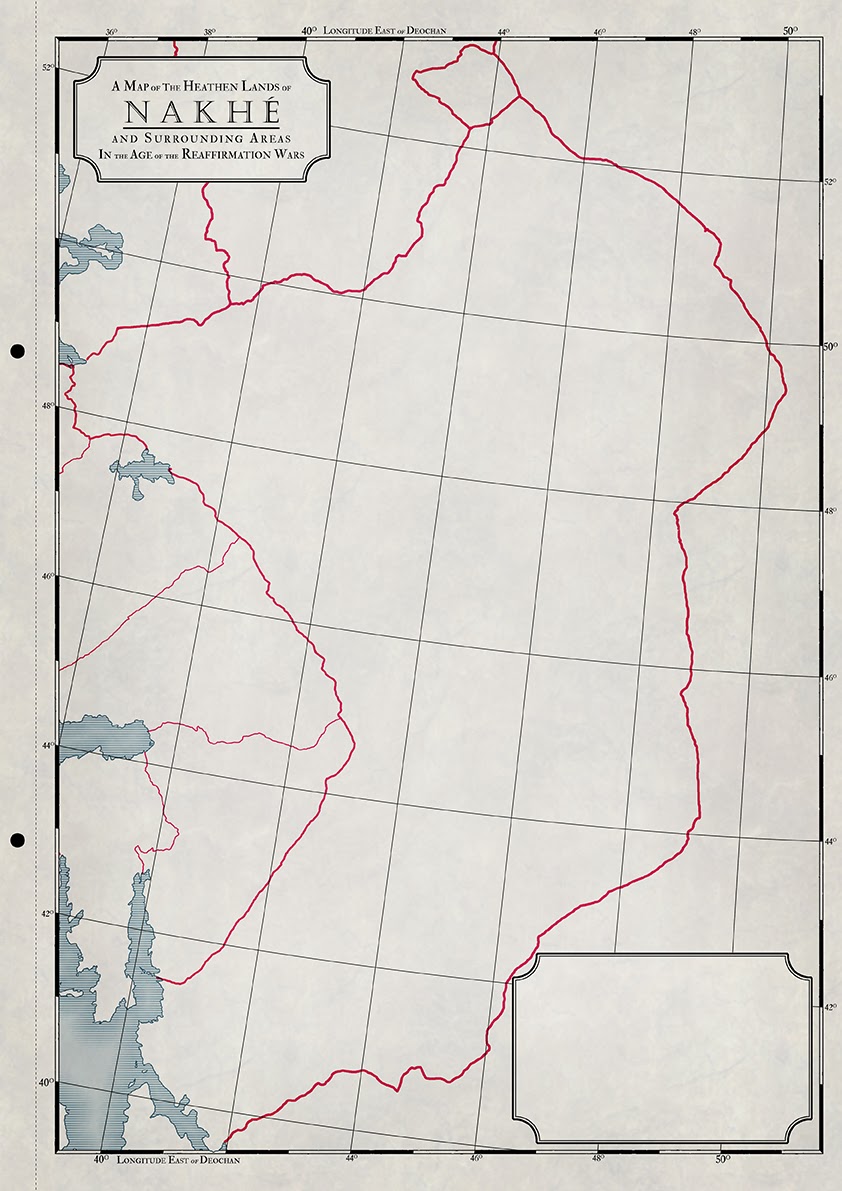
So, I’ve got some more work done on the Atlas entries as
well as some tweaks and minor adjustments that no-one other than myself is
likely to even notice and I’m getting closer to finding a style I’m happy with
(though I’m still torn about the mountains, though more on those later.
Of these new maps the most complex, by far is the one
detailing twin nations of Ahrishen
and Virahan. This is largely due to
the many lakes, the relatively small scale (compare this map with the one of Ezasuth, for instance), and the fact
that the regions to the west, south-east and east had already been mapped (Vârr, the Haréshk and Nakhé,
respectively) so there was a lot of back and forth between this map and the
older ones to make sure that everything (borders, coastlines, graticules) lined
up and scaled together correctly.
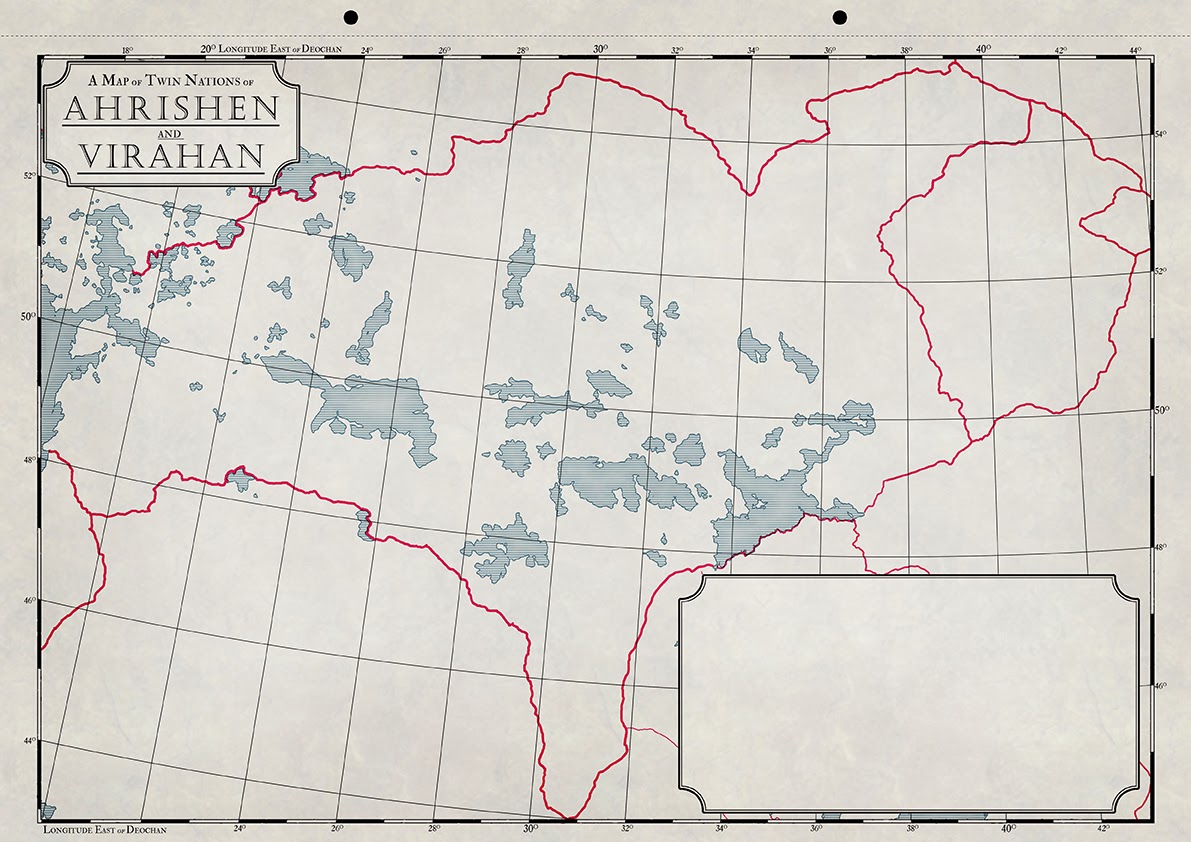 |
| Ahrishen and Virahan |
I think I done a decent job (though it’s far from done…),
though I realise that the maps are nothing much to look at at the moment and wont exactly be arty maps when they're done - they're political maps, detailing resources, roads, trade routes and such things and are functional rather than pretty,though I hope the Atlas can be seen as a work of art in some respects once its done. Also, the more maps I get done the more time-consuming the task
gets. Also, the more maps I get done means the farther away from my comfort
zone (Inner Sea) I get, which means more terra incognita: the lands around Korachan are very familiar as I’ve been working
on them for coming up to a year now, though the farther afield I move the more
unexplored certain regions become.
Take Ezasuth, for instance.
This is all I have written about it:
Ezasuth:
nation in Llachatul, just north of
the Sea of Marden. Was home to
explorers who settled lands in the far west of Llachatul, which would later become Ayad, Elat and Gyzha.
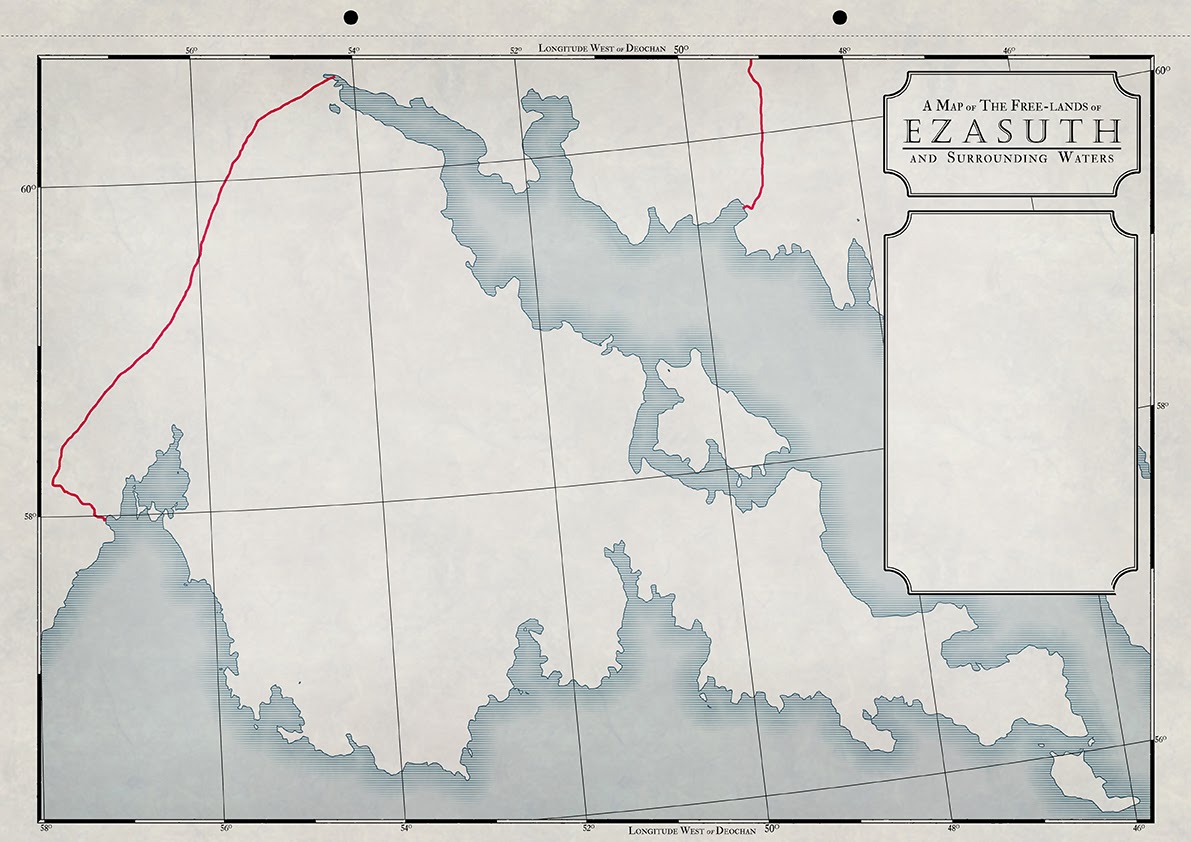 |
| Ezasuth |
That’s it. Pretty scary mapping a nation or which all I know
is two sentences of background, apretty tame background at that. No flavour or
characteristics that scream out as unique quite yet, but I’ll get there. I find
a lot of the worldbuilding (or nationbuilding, as the case may be) comes from
coming up with a rough vocabulary through which I can name regions and cities. History
and background comes naturally as I flesh the geography out and I then build
upon that. Of course creating neighbouring nations brings more history and synergy
which sees a lot of back and forth as I figure out interactions between nations
and peoples.
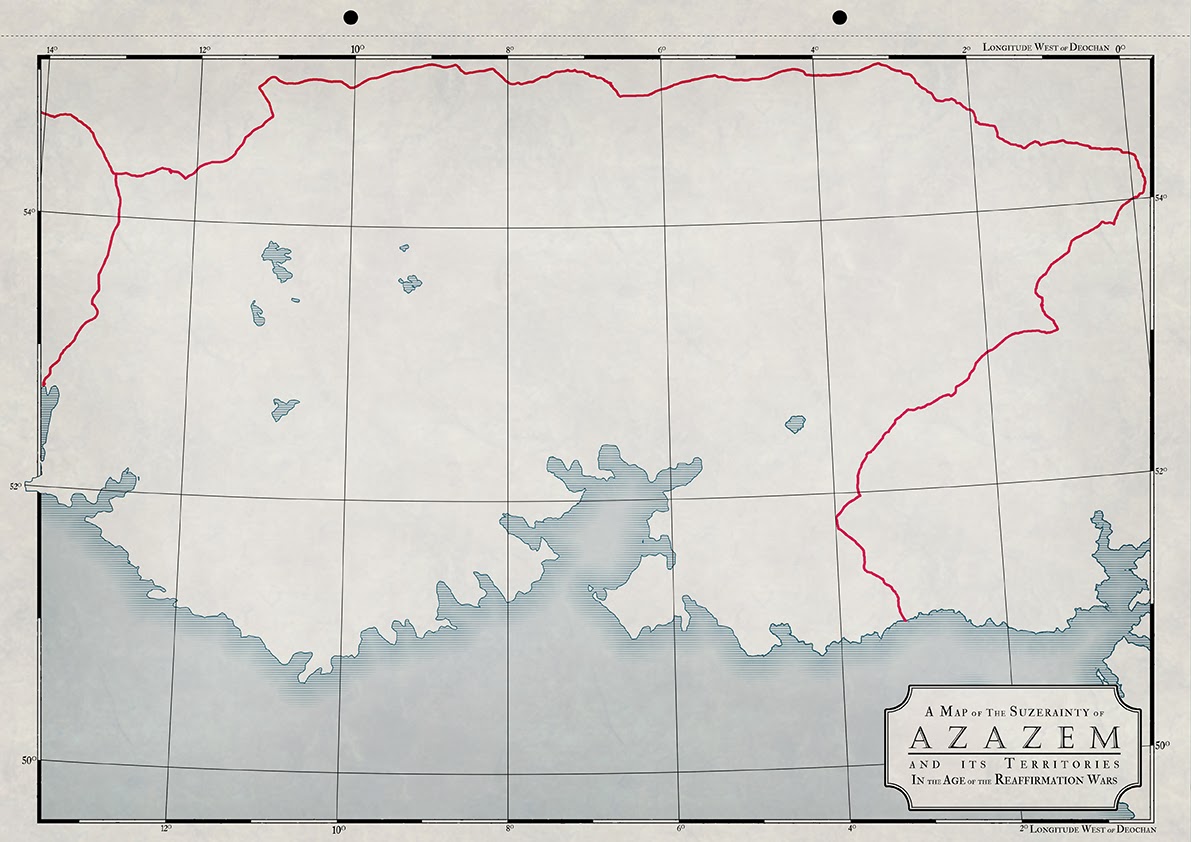 |
| Azazem |
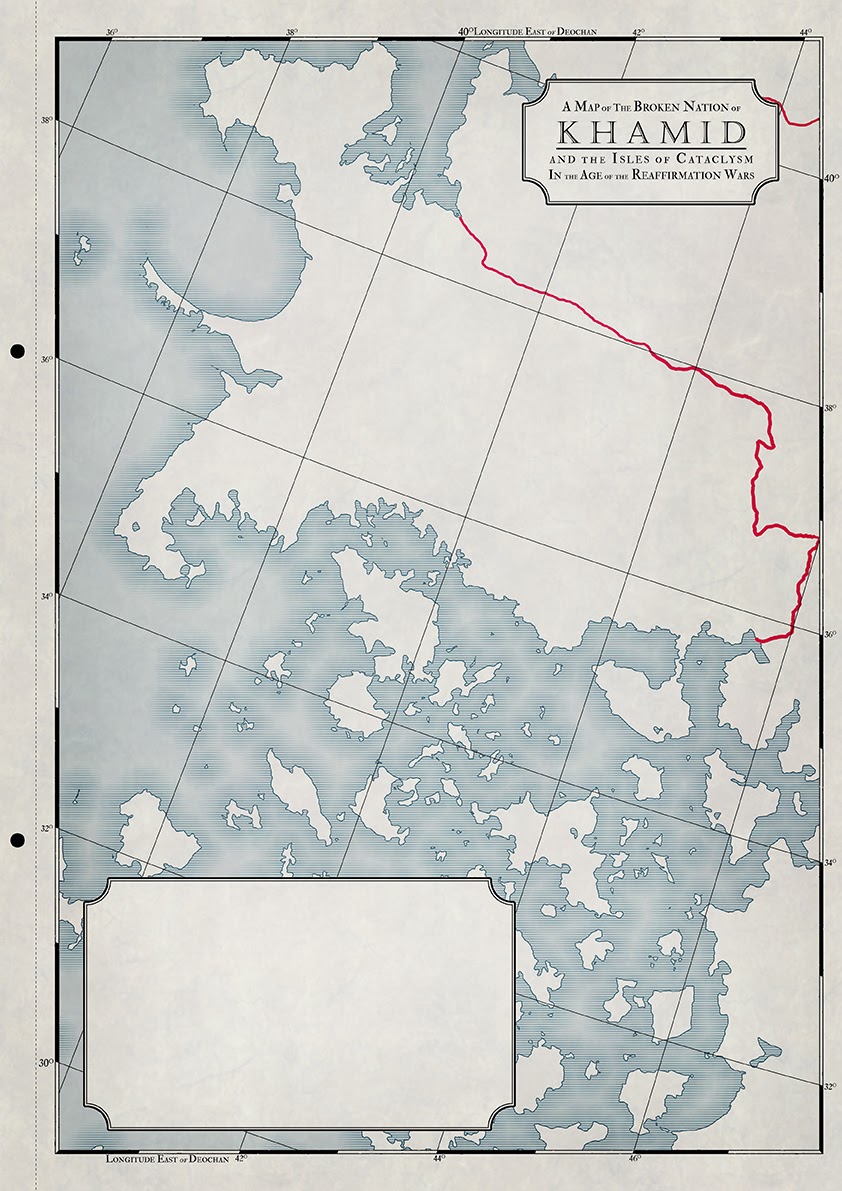 |
| Khamid |
 |
| Laaskha |
 |
| Mharokk |
 |
| Naareth |
 |
| Nakhe |
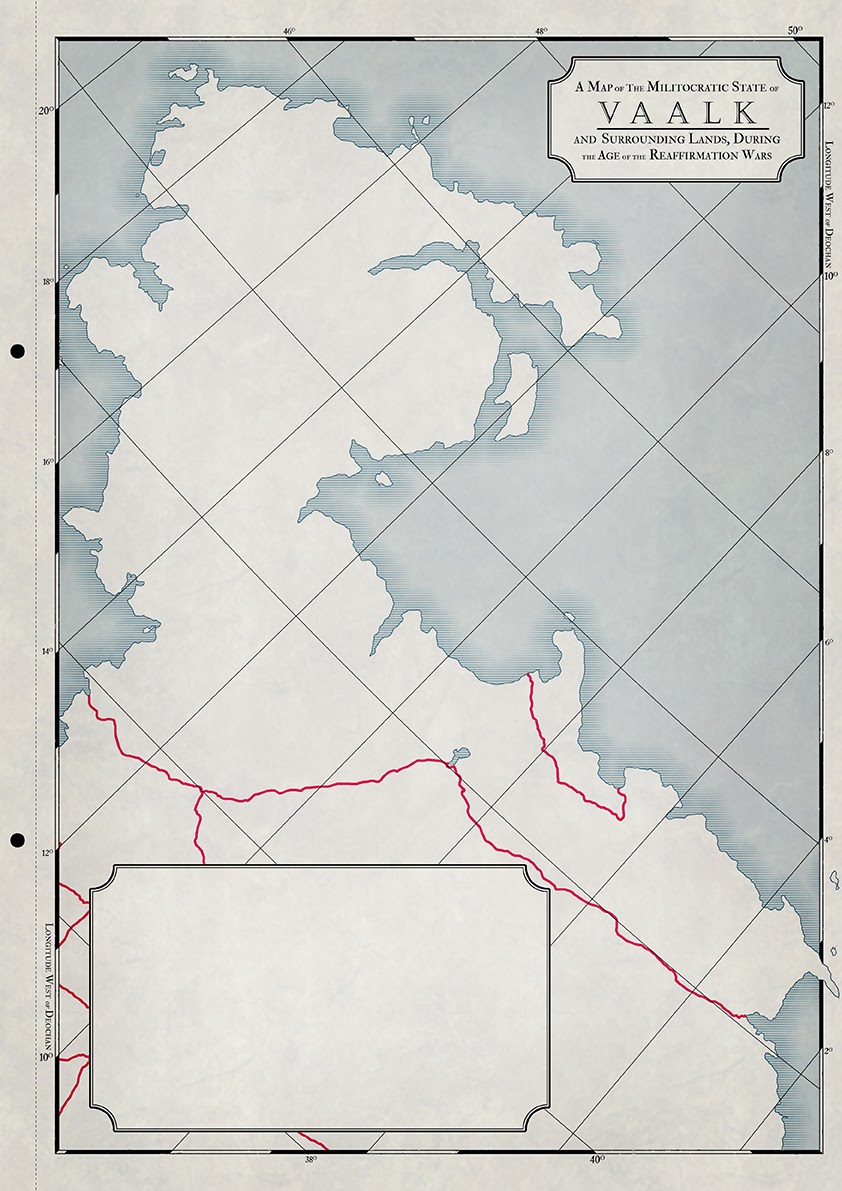 |
| Vaalk |
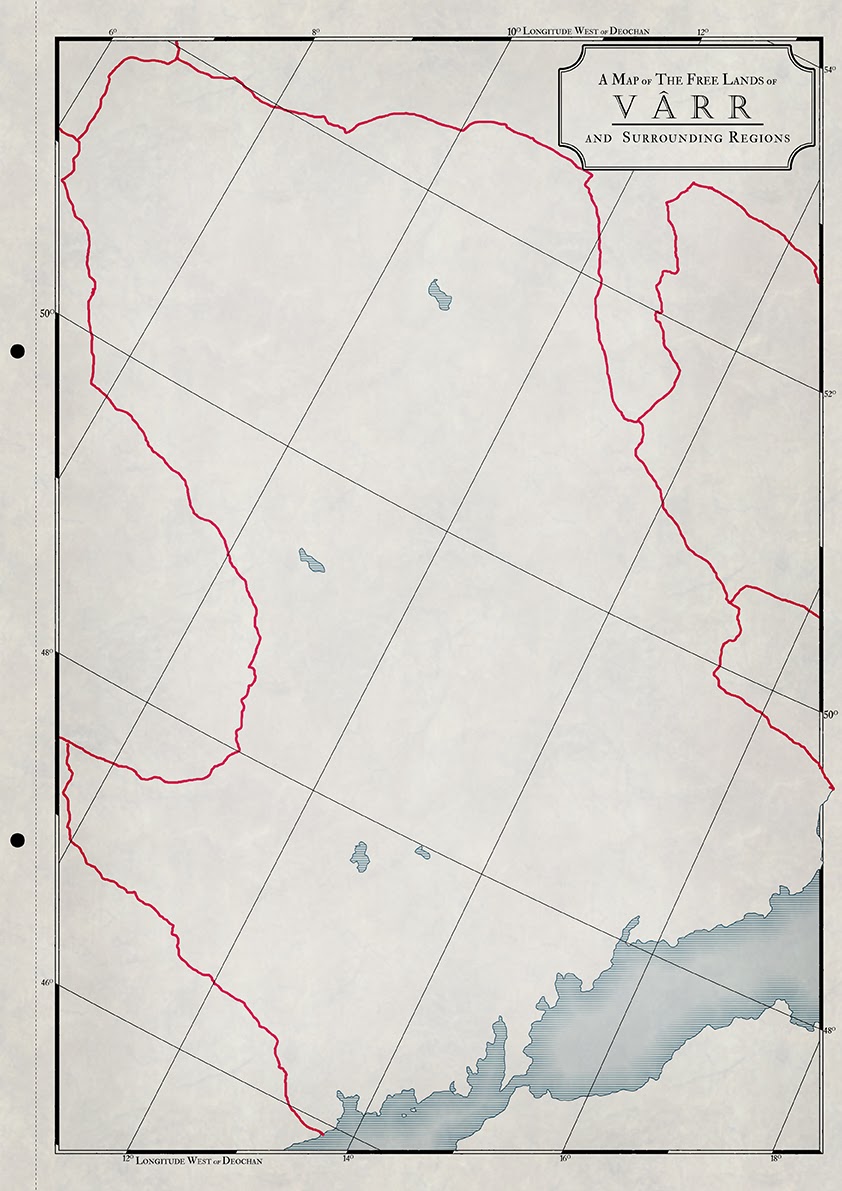 |
| Varr |
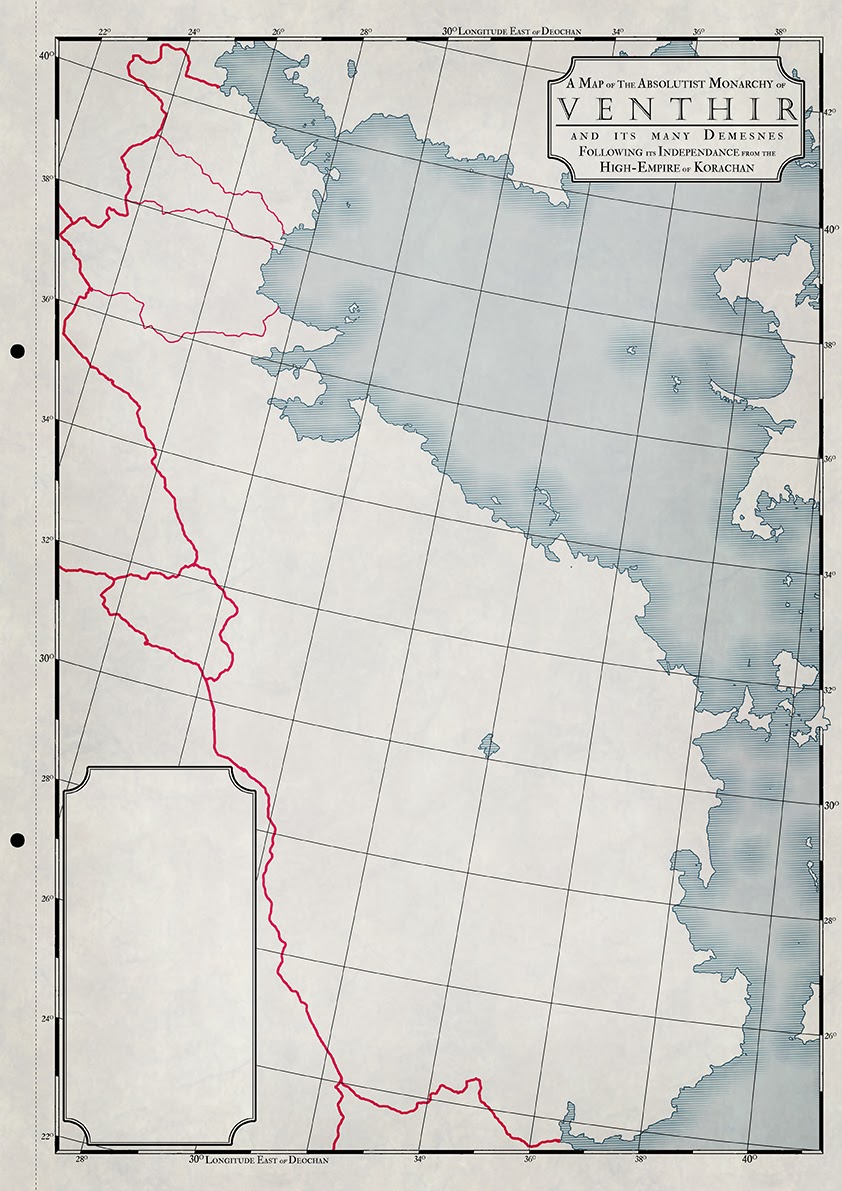 |
| Venthir |
I’m still unsure about a few things though, largely the territories
and borders (which appear in their most up-to-date form in the Korachan map I had
posted) and mountains. The territories are fine, though I’d like something with
a bit more texture. The mountains, however are getting me in a right pickle. Initially
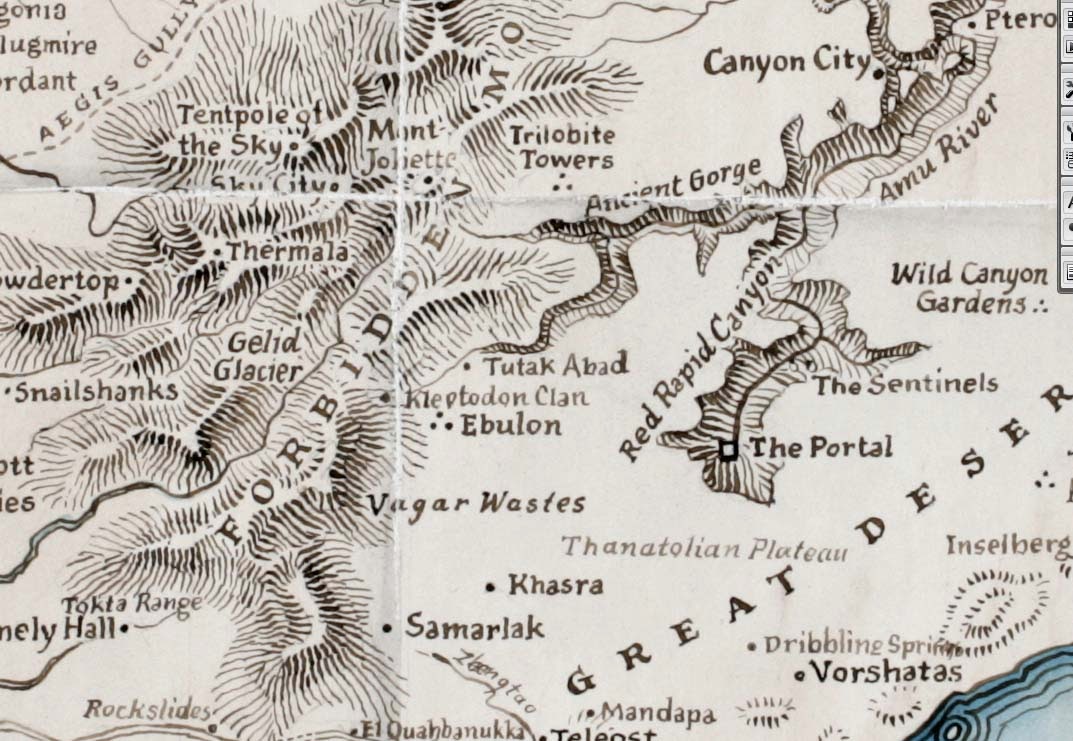
I’d though of something akin to the Dinotopia
map below, which is true to the generic time period though not necessarily
needed for these types of political maps. Though now I’m leaning towards
something more akin to the Mediterranean map posted beneath it. Though that
would entail a lot more work on my part and might make the maps more colourful
and busier than I had originally intended. Decisions…
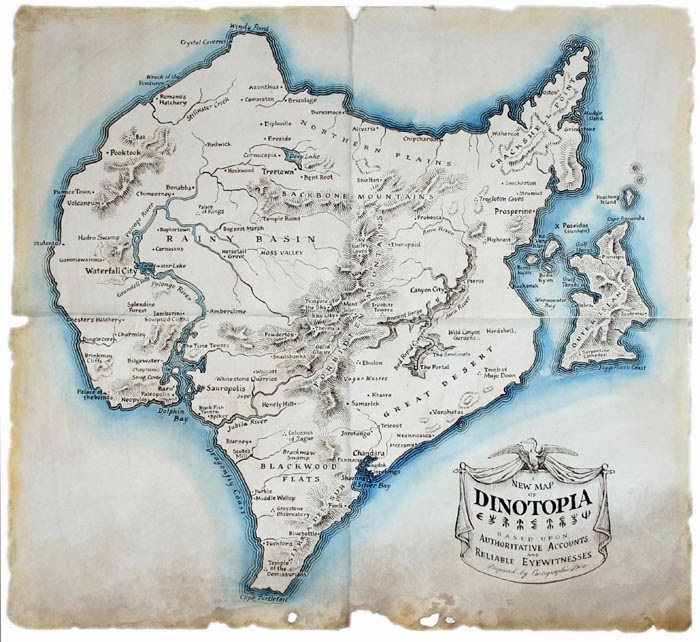 |
| Dinotopia |
 |
| Dinotopia detail - mountains and lettering |

22 February 2014
the Mortal Races
I thought I'd quickly touch upon something
that I haven't mentioned much before: the mortal races. Despite the fact that
humans form the vast majority of most mortal races in Elyden, that was not
always the case. The reasons for this human proliferation are varied. Firstly,
Most works of fantasy fiction, for one reason or another, have humans as the
protagonist race. I presume it’s just laziness or ease of worldbuilding –
creating cultures and histories for invented nations is difficult-enough as it
is: making them for alien races is something else entirely. It’s just easier,
as a human (yes, I’m human), to write something from the POV of a human than
another race. That’s not to say, however, that I won’t do it at some point.
Indeed, the protagonist of what I’m currently writing is not strictly human, so
I’ve already ventured into that territory.
Having said that I love the variety that
different race bring to the world and Elyden has varied sources from which I
can create such creatures: the Two-and Twenty mortal races (the asicthai), the Otherworlders (Isawhan) and Halfbloods (Anthropeidos). Scions (the offspring of
the demiurges and other creatures, normally asicthai)
do not fit into any of the other classifications and exist as a fourth,
unofficial one. I’ll talk about each race, in brief, mentioning the mortal races in this post.
Asicthai (mortals)
Literally translated from Korachani as ‘not-human’, this was once used in
reference to any non-human race, though over time it became a generic term,
interchangeable with mortal, or, more precisely, one of the descendants of the
Demiurges’ children: the Two-and-Twenty.
Though
referred to as the Two-and-Twenty mortal races (in mirror of their sires, the
Demiurges) the naming convention is not exactly true. Some races are now
extinct or have become so few in number or insular that contact with them has now
been lost. Indeed, the stillborn god Ryhassharauch never sired anything that
can be classed as living and opinion is divided whether or not his children,
the rarevas, can be classified as
mortals (for the sake of this essay I’ll include them with the asicthai).
Illidræn: one of the
Two-and-Twenty tribes, and children
of the Demiurge Allaishada. Often winged, normally of alabaster skin & dark
hair and serene dispositions, they are equated with angels by other races
(particularly humans who have a tendency of deifying them, often without true
cause), though they are far from perfect moral creatures. In truth, they are
beings of compassion so pronounced that they must resort to asceticism and
meditation to control their emotions. Due to their natures they tend to devote
their lives to single pursuits, which they perfect, becoming experts in their
chosen fields.
The race was
whittled to near-extinction during the Shadow
War that led to the fading between
the Fourth and Fifth-Ages, the remnants of the species dispersing and living out
the end of their race’s days as solitary eremites in forgotten temples and
ruins. To many they are indeed extinct though scholars maintain that scattered
individuals have survived, their natural longevity and asceticism a bulwark
against death and decay.
Serapi: one of the
Two-and-Twenty tribes, and children
of the Demiurge Ashterath, Name for
lizard-folk and dragon-kin cursed by the Demiurge
Talantehut to be servants to the sun and to crawl in the hot earth on their
stomachs. Their tongue is closest of any living creature to that originally
wrought by the Demiurges, before the cataclysm of the Bridge of Worlds. Little is known of their original form or
culture, only that it was their apparent sadistic nature that earnt them the
scorn of Talantehut, who changed
their form and that of their descendants forevermore.
They are relatively common in the sun-drenched parts of Elyden – such as the deserts south of Venthir and those dominating Kharkharadontis, though little remains of any culture save base primitive tribal structures. Some claim that in some regions vestiges of a more civilised form remain, though such claims are unsubstantiated.
They are relatively common in the sun-drenched parts of Elyden – such as the deserts south of Venthir and those dominating Kharkharadontis, though little remains of any culture save base primitive tribal structures. Some claim that in some regions vestiges of a more civilised form remain, though such claims are unsubstantiated.
Ifirmian: one of the
Two-and-Twenty tribes, and children
of the Demiurge Duruthilhotep, and
the first mortal race to ever shape the Firmament. They are now commonly known as the
immortal guardians of the Meniscus,
named after the eponymous continent. They are the most proficient Firmamentists
and are thought to be the closest in design to the original immortal races,
whose gestation was interrupted by the worldcrafting of the Demiurges, resulting in
the birth of the imperfect mortal races.
They
are slender people, tall, of long tapering heads and are not want to
communicate with others without dire need. They are rarely seen outside of the
lands surrounding the Meniscus and are thought extinct by most insular people.
Valthas: one of the
Two-and-Twenty tribes, and children
of the Demiurge Talantehut. They were once very similar to humans, though through
the long slow neglect of their Demiurge
mother became corrupted into something baser; grey things without passion or
hope or love. They became achromatic; creatures alive but without life, much
like their mother. Where Talantehut
was chosen to be a force of balance amongst her siblings, the valthasi were allowed to wither and die,
their mortality dripping away with every eon their mother ignored them until
they became the rotten shells that they are today, dwelling in the dark places
of the world where they can pass unnoticed, much like their incorruptable Demiurge parent.
Many
physical laws that affect the mortal races do not apply to the valthas, which
exist in a form of fugue between worlds – neither dead nor truly alive.
Dverg: one of the
Two-and-Twenty tribes, and children
of the Demiurge Synchthonith, though they maintain few open ties to their ancestry.
A few ancient temples have been discovered by Imperial explorers, hewn from
deep caverns, though all are eons old, abandoned. Mulls are also believed to be distantly related to the dverg, though having diverged long ago
they are now considered different races.
Stunted,
technologically aware mortals native to lands north of the Inner Sea,
originally centred around the Rhaecha
mountains, though rarely seen in the open. Their lands and clades were wiped
out millennia past by human expansion in the Fourth and early Fifth-Ages, and
now they remain largely as a caste within the Korachani empire, an
essential part to its industries. The Steel
Cataract was mostly built by dvergai hands. Very shy, rarely leaving
their underground clades, those seen in the empire are usually slaves and
technologists. Their pale skin and large black eyes are sensitive to light so
when seen close to and above ground they are almost always covered in thick
leather suits and tinted goggles; the accountrements of their trade. They show
little affinity for the Firmament or
the Penumbrism, though have a
cultural understanding of the latter and its applications within technarcana, and their seemingly innate
affinity for engineering is legendary.
Lhaus: one of the
Two-and-Twenty tribes, and children
of the demiurge Yaldabaoth. In their father’s obsession with seeking eternal life,
the lhaus became acolytes of the art of klados
and followed him down the path of eternal life. Over the eons and their
obsession with klados, they became a changed race, their goal of prolonged life
achieved yet not without cost. Like their father, those with the purpose
and means created secondary bodies (known as iterants) in which they would
transfer their spirits upon death to achieve prolonged life, or a vague
semblance of it. Each such iteration of an individual would bring with it a
body that was more grotesque and featureless than the last, until, after dozens
of such iterants had perished, the original person would be lost beneath a
hollow shell that was consumed by its obsession with life.
By
the early days of the third age the leaders and upper echelons of lhaus society
were embroiled with seeking the mysteries of klados and lhaus culture broke
down, the tribes of lesser beings –
unable to follow their masters in their pursuit – began a diaspora across
Elyden, where their blood became diluted with that of other races and they
eventually died out, their father too preoccupied with his own obsession to care.
Those amongst them who achieved true eternity through klados became miserably secular creatures, their time spent researching better ways to achieve
immotality, their thousands of followers, retainers and slaves existing only to
aid them in their quest. Their solitary city-states warred against one-another in
the pursuit of resources and chemicals needed in their timeless compulsion. By
the latter days of the Third Age the lhaus were reduced to a few dozen miserable
totalitarian city states, hidden from the rest of the world in western
Kharkharadontis. Memory of their tribe was almost lost by the dawn of the
Fourth-Age and it was only the actions of the aggressive city-state of Thamaaz
(over a thousand miles south of what is now known as Erebeth) and its ruler,
Leontoeida, Lord of the Clades, in the mid Fourth-Age (c. -4500 RM), who
scoured the lands around his city for miles around, searching for further
secrets to immortality and his arsenal of slumbering klada. With the increase
of the Shadow in the Desert and the world's decline, contact with the city
was lost and the lhaus survive in Thracian legends and the Yothshammanei
tablets, found in a temple in the north-eastern Daened Sulrach in c. 750 RM
that is believed to be a mortuary complex dedicated to the wasted iterant of an unnamed
Clade Lord.
Little
is known of the original appearance of the lhaus though various records of the
general form taken by the Clade Lord iterants are known, and are commonly
dscribed as grotesque: exposed musculature over porcelain-like bones of artificial manufacture. Most have intricate head crests, like shields, and are without sensory organs of any kind.
Plagi: one of the
Two-and-Twenty tribes, and original children
of the demiurge Rachanael. Of dark skin, red eyes and horned brows, the plagi were
a powerful if not populous tribe, their martial prowess and penumbral skill
earning them the enmity of many other tribes. Their territories were never
expansive, and they rarely emerged from the gargantuan dry basin that makes up
what is now the wasted land of Kharkharadontis.
Though considered by others to be children of the Penumbra, they were not
immune to its effects and survived its corruption largely due to the aegis of
their father Rachanael.
With Rachanael’s imprisonment in Daekyn in the dying days of the Fourth-Age, the plagi
were left leaderless. At the mercy of the Penumbra,
their bodies became prone to corruption. To escape its effects, many amongst them
left Kharkharadontis in a great
exodus that saw them travelling south, where they would become lost to imperial
annals; and north and north-east to the to the Daened Sulrach and Umbra Solare, where their breeding with humans would dilute the race into
what later become known as the Etheri
Nomads.
The few that remained in their homelands
haunt the regions around the pit of Daekyn,
never moving far from their father's prison, little more than mindless husks driven by a consuming bitterness. The Archpotentate Malichar’s arrival there in 212 RM saw the
remaining plagi join him in his travels where they sojourned in Nyala before aiding him in the
construction of the Leaden Throne,
upon which the newly-liberated Rachanael would be interred. With that deed was
the long history of the plagi ended, their last known descendants becoming
known as the demiurnes of Rachanael. In their place Rachanael
adopted humans as his children.
What few true plagi remain do so in isolation
or in distant lands, inhabiting the near-mythical metropolis of Kharakhara, their sorcerer-kings protecting
them from the foulness of the Penumbra
there.
Giganri: (Imperial:
sûnéanthros, compare with anthslach). One of the original Two-and-Twenty mortal tribes, the
children of the Demiurge Urakabarameel. The Giganri, alongside humans,
are one of the tribes that have changed the least since their original creation. They are referred to as goliaths by the Korachani empire and
giants by nations farther east, which have had even less contact with them over
the years. The giganri are an insular
race, separated by the rest of Elyden
by the near-inassailable natural wall known as the Black Mountains that
flanks the western shore of the Skarosian
Gulf and the treacherous waters of
the Sea of Serpents in the west of the Inner Sea.
They stand roughly twice the height of an average
humans, though their legs are proportionately longer than those of humans,
giving them a somewhat lanky gait. Despite this they are prodigiously strong
of both body and mind, with their culture placing a great deal of importance in
asceticism and martial perfection and moderation. Their bodies bear signs of an
earthly heritage, and their skin is cold and rough to the touch like the
granite and marble from which legend (falsely) claims they were shaped.
Likewise, their skin can range in colour from alabaster-white to obsidian-black
and a myriad of other colours in-between.
Though little is known about them, it is believed that they are a race of many castes, likely determined by their colouration, with different castes including the upälant, a black skinned variety that is the most documented by Korachani explorers and traders of the Skarosian Gulf, sometimes seen in the mines of Adamati, though any attempts to follow them back west invariably fail. The maramari are an off-white colour with green veins and are the most silent and morose of all giganri encountered, pensive and slow to action. Carnous are red-brown skinned, and stand taller than others, appearing to be a martial caste.
Though little is known about them, it is believed that they are a race of many castes, likely determined by their colouration, with different castes including the upälant, a black skinned variety that is the most documented by Korachani explorers and traders of the Skarosian Gulf, sometimes seen in the mines of Adamati, though any attempts to follow them back west invariably fail. The maramari are an off-white colour with green veins and are the most silent and morose of all giganri encountered, pensive and slow to action. Carnous are red-brown skinned, and stand taller than others, appearing to be a martial caste.
Generally, the Giganri are introverted and quiet
beings, likely to be considered slow by other races for their reticence to
speak that stems from their calculating natures. Little is known of the culture
save their extreme asceticism and their devotion to the philosophy of alchemy
and Gnosticism, lending them a mystical air.
They are
amongst the more populous mortal races, after the dominance of humans and are
common in both western Llachatul, as well as Menisucs. It is commonly believed
that oghurs are a degenerate offshoot of giganri, with many blaming penumbral
taint or cannibalism as their source.
the Forgotten: One of the
original Two-and-Twenty tribes, and
children of the demiurge Abufihamat (later known as Baphomet). Once one of the most powerful
and wealthy of the Two-and-Twenty
tribes, they were oppressed to the point of desperation by Abufihamat. A few amongst them came to secretly worship a
diametricly opposed corruption of the Demiurge,
who became known by the name of its idol – Baphomet.
These heretics were persecuted and slain without abandon, though their roots
were set deep and the cult spread. Abufihamat,
punished alongside the rest of the Two-and-Twenty,
fell from grace, greatly weakened. That, coupled with a tribe that was rapidly
abandoning it for the blameless excesses offered by Baphomet, almost destroyed Abufihamayt,
who sought the aid of the heretics, offering them that which they sought in
return for fealty. It was granted, and Abufihamat
finally died, replaced by Baphomet.
Baphomet ignored its
true children and instead sought the embrace of alien tribes, who it bribed
with gold and fecund capriform idols. Growing weak and sickly from their
excesses, Baphomet’s true children
were allowed to all but die, surviving in minute numbers that scattered from
their homeland in bitterness.
Since that time the handful of Baphomet’s true ancestors survive as
strange alien beings, their bodies tall and gangly, their features inhuman,
that live on the fringes of society, in places shunned by civilisation –
marshes, wastelands, barren places. Known only as the Forgotten, any memory
of their past history relinquished, they are now neolithic hunter-gatherers,
sullen, aloof and xenophobic, living in large communal tents, as they once were
under the auspices of Abufihamat.
Vapula: One of the
original Two-and-Twenty tribes, and
children of the demiurge Arimaspi. Though
arimaspi is known for the many creatures and beings that he created, his true
children are the vapulim. Humanoids standing around 7-feet tall, they are
bulky yet graceful, with leonine features and feathered backs, heads and
forearms and tool-wielding hands with opposable thumbs.
They were
once a populous race dominating the arid lands of the ancient world, though have lessened over the march of time. They have been thought extinct for many years
though a relatively large number were found to remain in the nation of Datepha on the island of Isea, in the south of Elyden. What led
to their diminishing across Elyden is unknown and little reference is made to
them in the Mythologia Elyden or other ancient texts. This is likely, as though
the vapulim are Arimaspi’s true children, they (like the other mortal races) were
not crafted through his direct actions. He is known to have poured his love and
passion into his other creations (like the aiklahs, eelyouhns, haagenti,
griffins and sphinxes) and likely abandoned the vapulim.
Sieth: one of the
original Two-and-Twenty tribes, and
children of the Demiurge Neith. Very little is known of them
other than their association with the Ivory Moon and their purported homeland
in what is now Malan.
Shie: (also Shy) one of the original Two-and-Twenty tribes, and children of
the Demiurge Sybaris. They are of russet skin and possess four arms with
delicate curving horns atop their brows beneath which glare feral yet beateous features. Like their mother,
they are beings of carnal passion and are epicureans.
Never a numerous
race, they largely excluded themselves from world-wide events and are never
noted as participating, as a race, in any large wars or conflicts. Instead they
are largely recorded as explorers of the contemporary world and pockets of them
can still be found in small numbers metropolitan regions, where they can
mostly be found as individuals, studying hedonism.
Catachis: one of the
original Two-and-Twenty mortal races,
and children of the Demiurge Dopellanich. Though extant examples are
rare, the histories of Elyden
describe them, much like their primogenitor, as dualistic beings. Twin births
are the norm and as such their societies across the continents and time have
always revolved around the sacred bond between siblings and in many respects
twins were regarded as a single person in two bodies. Conjoined births were
somewhat common and of a more stable form than similar births amongst other
mortals, which are seen as an aberration of sorts. As such they were regarded
as high-born, granting measure of prestige upon their families and commonly
becoming part of the priestly-caste. Single births are conversely seen as weak
and such unfortunates tend to live hollow lives of ridicule, often forcing them
into self-imposed exile.
Physically, they are little different to
humans, though their craniums are slightly bulging when compared with humans,
and their fingers are long and delicate, though neither can be use to truly
identify such mortals. Conjoined twins usually take the form of a symmetrical
four-armed body (one pair smaller than the other, below it, often considered
vestigial and bedecked in jewels amongst the wealthy) and a single head with
two faces, one facing left, the other right; though other less symmetrical
morphologies are common.
Irkalla: one of the
original Two-and-Twenty mortal races,
and children of the Demiurge Nergaal. Little is known of these people, save the tantalising
clues left behind on subterranean monoliths on the island of the same name, off
the south-western coast of Cuth. What
little we know is that they were a base civilisation in which the sick were
worshipped (seen as favoured of Nergaal)
and the strong broken of their will and used as slaves. A sun cult was (despite
the subterranean nature of the monuments on which the records were found) at the
centre of the race; though where other sun cults deified light and warmth, this
cult saw instead the need to pay tribute to the devastating nature of sun;
drought, plague and heat. This might be indicative of the races’ retreat to the
caverns beneath their home; perhaps as a sign of reverence or fear.
Irothan: one of the
original Two-and-Twenty mortal races,
and children of the Demiurge Nyarloth.
Little is known of this race other than it was all but destroyed following a
brutal civil war. The war came about following the internment of the Demiurge Nyarloth within a soul-engine, following his murder at the hands of
the Demiurge Rachanael, who helped
him construct the machine (with the intent of using it for his own gain). His
body remained, becoming a stone-like edifice known as the Host.
The majority of irothani came to worship the
Host, rather than the contents of the
engine, leaving Nyarloth weak and in
a state of torpor within the Soul-engine.
The irothan rulers, known as Septs, knew the error of this idolatry
and tried to persuade the people that their god was the machine and not the
idol, but most people did not listen, this resulted in a civil war that tore
the ironthani empire asunder,
bringing to an end one of the largest and most long-lived mortal empires in Elyden.
Physically they were similar to humans though
their skin had a bluish tint and their eyes glowed as though with an inner
light.
Aithar: One of the
original Two-and-Twenty mortal races,
and children of the Demiurge Malachai,
who became corrupted into the Alakhi (or ‘bidekin’). Little is known of the
Aithar, though the Al akhi, which survive in Stolas, north of the Empire are
well-catalogued. Like their ancestors, the Al
akhi are an insular race, regarded as
somewhat of a rarity to most outsiders and unknown to those in distant lands.
They stand roughly 6 – 7’ tall and are of
emaciated frames and overlong spindly limbs (their totem-lords [primitive
priests] in particular seem to suffer from the condition). Their bodies are
hairles, though primitive feathers (often spine-like) are common on their
forearms, backs, necks and shins, which are more prominent on males. Their
heads are muzzled by long slender beaks, which limit their vocal abilities (al akhi
language is nonetheless complex, and relies heavily on the written form; seen
in their many rune-tablets and cavern-epics). The al akhi are prone to
distorted features and aberrant forms are not unusual, with a rare few
appearing as little more than misshapen beasts.
Al akhi society is tribal and revolves
heavily around idolatry: traditionally that of an anthropomorphic avian totem
known as Merkabh, which is believed
by scholars and mythologists to be a corrupted form of the now-dead Demiurge Malachai. Males are dominant in
these societies, though females do play in important role in the creatures’
primitive religion. Important members of society are mummified and placed in
niches within family hovels, where they remain with their tribes as ancestral
figures, who the birdmen pray to in times of personal trouble (in a practive
similar to Sauan and Temujan ancestral spirit worship).
Like most of Elyden’s beast-men, al akhi
are fetishists and of a poor technological position. They fashion crude metal
weapons but seem to have little affinity for clothing and armour beyond rags
(they wear little clothing and use heavy wattle shields only rarely), though
they have been known to scavenge ruined metal from the Desolation
of Astudan (particularly the passage
the Red Route takes through it on its way to Gâtha), though such forays outside Stolas are rare or sporadic at best.
Human: one of the
Two-and-Twenty mortal tribes,
and the children of the Demiurge Avraham
the White King. Humans are unique in that they are the only mortal race that
can breed with other races naturally and unaided (physical restrictions
permitting), leading to many various half-breed races and creatures. None truly
know the origins of this trait, though it is believed to lie within the nature
of their father, Avraham.
Humans
were abandoned by Avraham following the appearance of the Azor (descendants of
unions between humans and his scion Azer), whom he regarded far more highly. Humans
were later adopted by the Demiurge Rachanael.
Keratin: one of the
Two-and-Twenty mortal tribes,
and the children of the Demiurge Kharani.
They resemble humans in most ways, with males averaging 6-feet tall and
weighing 180 – 190 lbs. They are heavily built, with powerful bodies and hard
bony ridges on their elongated heads, with horns prominent amongst males and
often seen as a mark of strength. Their skin ranges from pale grey to a dark
brown, with various shades in between, and a red tint is considered as a sign
of virility.
Much
like their Demiurge father, the Keratin are a passionate people, quick
to anger and skilled with their hands – something that they commonly apply to
the crafting of weapons and tools and cenotaphs and triumphal arches. Their
culture traditionally revolved around a stratocracy or kratocracy, with the
strong ruling the weak, commonly under a militaristic regime.
Though
a strong and united race, the Keratin
were relatively few in number, particularly when compared with the vastly
superior humans. Their numbers dwindled during the Shadow War that ended the
Fourth-Age of Mortal life, where they allied themselves with Rachanael and were used as shock troops
to deady yet phyrric effect.
Deruweid: one of the
Two-and-Twenty mortal tribes,
and the children of the Demiurge Achaiah. They are generally tall (between 7 – 9
ft.), with their skin undergoing a transition throughout their long lifes. The
young have malleable greyish green skin that flakes at the joints (like
sloughing birch). As they grow older their skin appears to calcify, becoming
darker and tougher, like gnarly bark. Hairless, they are an ascetic race,
without cities or clothing; aloof and xenophobic, living the last of their
declining days in the shadow of their Demiurge mother in the deepest reaches of
the Nameless Forest.
Abandoned to
their own devices with their mothers’ transformation into the Immortal Tree Agen,
the deruweids filled the void left in their lives with bodily mutilation,
thought by contemporary scholars as being a form of chastisement for what they perceived
to be their own faults. The deruweid s dwindled over the years, though
eventually those who remained in their old homeland (in what is now the Nameless
Forest) would rediscover their old mother, realising the true error of their
ways, devoting their lives to maintaining the Tree of Agen and slowly shaping
their bodies in her image.
Ropohaii: one of the
Two-and-Twenty mortal tribes,
and the children of the Demiurge Vorropohaiah.
Swallowed by the Prison Carceri in antiquity, little is known of this strange
race other than the madness which is known to have been passed down to them by their father.
Merill: one of the
Two-and-Twenty mortal tribes,
and the children of the Demiurge Shibboleth,
and the only known aquatic (or semi-aquatic race). There are seven different
lines of merill: one for each of the original mortals that came into being
following the shaping of the Demiurges, though of seven only one remains strong
(or known), with the other diminished and corrupted: for the torrent that once
sustained them is now gone.. They are most well-known amongst other races for a
curious trait known as genetic memory, where a newly born merill inherits the
memories of all its direct ancestors, all the way back to one of the original
seven merills. As a result they are brimming with emotion and memory, though have
little empathy, particularly with other races. They are beings of emotion,
though unlike keratin and illidraen it is not a personal passion, but an echo
of their many ancestor's lives – pain, suffering, love, loss death. Most
surviving members have been driven mad by the weight of memories that bear down
upon them, and every generation grows slowly more maddened. Indeed, in many
respects they are the closest of the mortal races to the Otherworlders.
They
are linked to the river Shibboleth, which bears more than just a name in common
with their demiurge forebear. They each undertake a long coming of age ritual
by going upstream to the river’s main source, where they immerse themselves in
the water. This somehow causes them to reach sexual maturity (Some scholars
think this is due to certain chemicals in the water or some other physical
effect that causes a metabolic change), though the proliferation of humans
around the river sees fewer and fewer merills complete this arduous ritual.
They tend to
talk in stream of consciousness, which is difficult for other mortal races to
understand. Very little is known of them, and what is known is likely
misunderstood though as Elyden’s seas retreat, soapstone metropolises have
begun to appear in the middle of once-submerged seas, built on volcanic atolls.
Where they survive they rely on coastal raids on ill-protected places far away from
the Korachani empire.
Rarevas: one of the Two-and-Twenty mortal tribes, and the children of the Demiurge Ryhassharauch. The children of the stillborn demiurge, These beings were cursed before their conception and exist as void, hollow, wretched things more akin to languid corpses than anything living. The stench of vinegar and rotting flesh surrounds their bony grey bodies. They keep their umbilical cords and make necklaces out of them in memory of their catatonic god. Legends claim that only seven exist in a fugue state between life and death, unable to die or reproduce.
Subscribe to:
Posts (Atom)