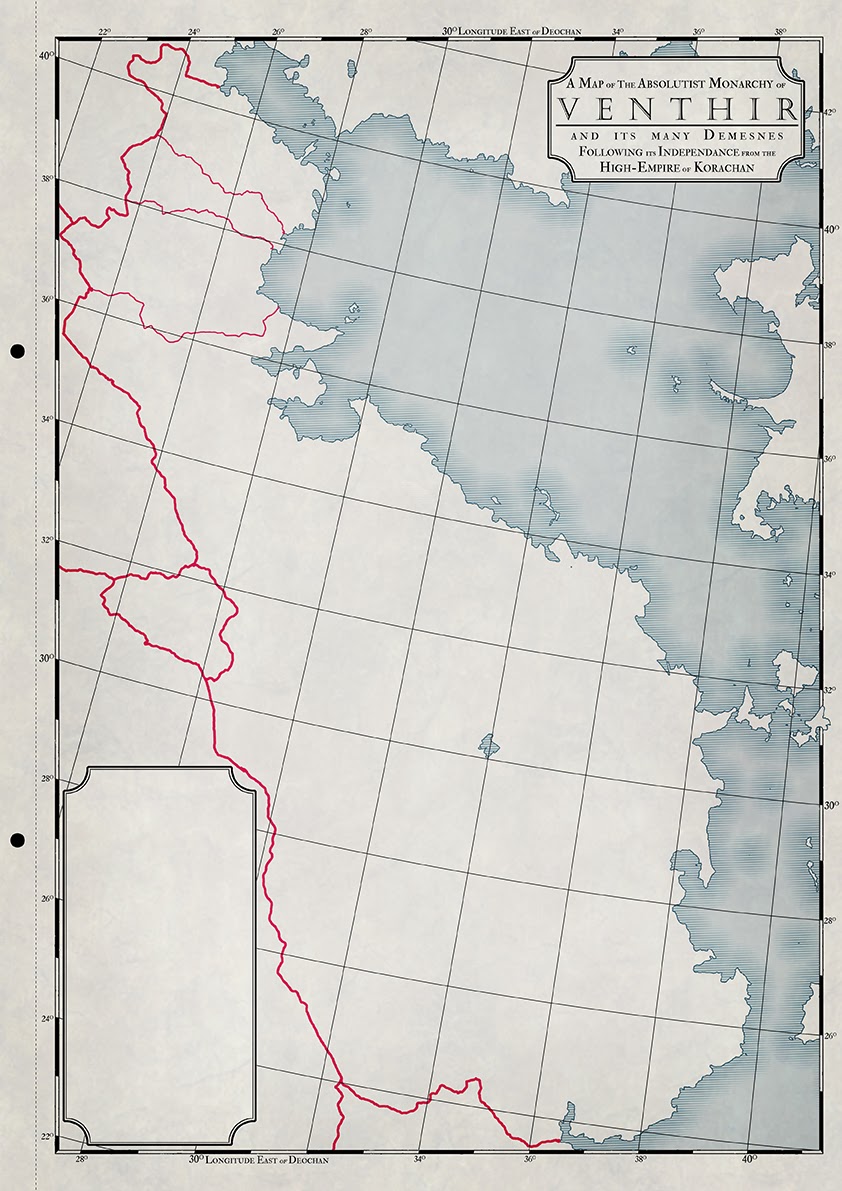
Nation
and natural successor to the Venathi empire that dominated the northern area of
the Arid Triptych region, to the north-east of Sarastro and the north of the
Anubian desert. For the majority of its existence Venthir has been a vassal of
the Korachani empire, though it has enjoyed a degree of autonomy throughout its
occupation unlike others conquered by the Archpotentate Malichar’s armies. This
is largely due to the presence of the vastly powerful and unpredictable sphinx
regent; Hetepheres, better known as the Strangler.
The nation of Venthir appeared
as a natural progression of the earlier Venathi empire, which through the death
of its charismatic leader Labaisingh, the so-called 'lion king', in 151 RM and
the subsequent rapid loss of its conquered nations, crumbled by c. 190 RM. The Venathi capital had been ailing for decades. Its coastline, like that of all
Venath, had been slowly retreating over the centuries, leaving its ports and
harbours land-locked, its once-thriving trade dead. The ruling Asanate had never
re-established control following Labaisingh’s death, and the entire region was
allowed to degenerate into strife.
Hetepheres, her whereabouts unknown since
57 RM, returned to the city of Hetepheropolis in 194 RM. Her reappearance
helped stabilise the region, cementing her worship amongst the people of what
remained of the Venathi empire. Her religion prospered and from Hetepheropolis
a measure of law and order was restored to the region. Her armies helped secure
nearby cities over the next years, attracting disenfranchised people from all
over the empire. The Asanate, though still embroiled in its own internal
struggles for power, saw the threat and opposed her, meeting her fanatical army
in a pitched battle in the plains outside Hetepheropolis in 200 RM. Their
armies were crushed, which allowed her to sack the city, inviting its populace
into Hetepheropolis, which became the capital of Venthir (which was in the local
dialect; Venath) in 201 RM, leaving the city of Venath to crumble.
Hetepheres’ rule was harsh, though under
her aegis were order and trade restored to Venthir. The retreat of the
coastlines which had dominated the dying days of the Venathi empire became a
major rebuilding effort, with dykes and channels built to connect once-coastal
cities to the Dark Sea. Its trade-routes were re-established, and tentative
trade reappeared with Sarastro and imperial-Nárthel, where the first true
contact with Korachan was made. In the absence of the Archpotentate Malichar
the Korachani empire’s expansive nature was somewhat sated, leading to trade
and diplomatic relations. In 211 RM Korachani diplomats and Set established a
permanent embassy in the city of Midal where alchemical secrets were traded. The
city prospered, becoming a major scholastic centre once-more, its cossetted
harbours in the waters of the deep Kalaun depth largely unaffected by the
retreat of the Dark Sea’s waters. Korachani influence slowly began to permeate
Venthiri culture in the following years, reaching its crux in the city-state of
Teira, which welcomed the influx of imperial merchant-dynasties and patrician
houses (most notable amongst them that of Ashura). Their presence brought
increased trade, which allowed the city-state to grow in size, its
artificially-built canal-harbours seeing much traffic from the west.
But it became clear that Korachan’s
imperialist nature could not be contained. Zion was conquered in 212 RM and
within a decade it had declared war on Sarastro. The war was long and bloody,
the absence of the Archpotentate Malichar affecting imperial morale, but in 231
RM the city of Carula was taken. It was clear that if Sarastro was taken,
Venthir would be next.
By that point, Queen Hetepheres had
secreted herself inside lavish odah-chambers within her temple-palace in
Hetepheropolis, leaving the Asanates to rule in her stead. Following her rise
to power she had slain the most power-hungry amongst their kin, allowing those
who swore loyalty to her to languish as regional rulers who met in council
every season before her to discuss important matters. The Asanate met with her
in early 232 RM, bringing news of the war to her attention – she dismissed them
without care. As the Korachani armies continued to slowly advance across Sarastro the Asanate, alongside Hetepheres’ closest advisors secretly decided to
aid the struggling nation, and sent reinforcements west in 233 RM against the
Queen’s edict, whose languid nature allowed the move to pass unbeknownst to
her. In Sarastro, the war became deadlocked, each loss counterweighted by a
victory elsewhere. Every victory was phyrric and armies destroyed one-another
over territories that mattered not. But were it not for the presence of
Venthiri troops, Sarastro would have fallen. If they managed to push the
Korachani troops back, the Asanate believed that they maintained enough power
to assume control of the remnants of Sarastro.
In 318 RM an imperial lictor infiltrated
Hetepheres’ massive palace in Hetepheropolis and told her of the war. She
emerged from the palace enraged, slaying slaves and servants with equal
abandon, ordering the armies’ retreat from Venthir. Upon their return she
strangled the entire Asanate and their direct families, banishing their
relatives from Venthir. Her actions earned her the moniker of the Strangler
Queen, which she propagated herself in a bid to foment fear. Her tyrannical
actions served to instil awe and fear in the populace and her presence became
constant; idols and temples erected in her honour in every city, the statues
serving to remind all that she was their ruler, and her word was law. The
sphinxes telepathic abilities allowed her to maintain a vigil over her nation,
using a few trusted religious followers who had kept her religion alive in her
absence as lieutenants and proxies.
Despite the war, Korachan had maintained a
presence in Midal and Teira, both of which had steadily grown more
imperialised, to the point that their dominant institutions had become the
patrician houses, whose presence slowly trickled throughout Venthir. Teira
itself had become a major influence in the region by c. 350 RM and existed as
an entity apart from Venthir proper, a small nation unto itself. The discovery
of a potent artefact known as the Sphere of Dominion in the Go Bisammam desert
in southern Venthir by explorers from Teira in c. 300 RM brought further
influence to the region. The sphere was a large depiction of Elyden as an
uninterrupted globe, ancient beyond reckoning, its construction or heritage
unknown. The item was used in the coming centuries by Venthiri explorers to
help chart the seas east and south of Venthir, where they made contact with
indigenous peoples, establishing colonies there
With the withdrawal of Venthir from the
War, Korachan was able to take Sarastro (though only after the reappearance of
the Archpotentate Malichar in 339 RM). Imperial influence in the region
continued to increase in the ensuing decades, with Teira and Midal in
particular seeing much imperial trade and traffic passing through them.
Imperial pressure was to increase until 359 RM, where history took an
unexpected turn.
Little is known of the events that led to
Queen Hetepheres’ abdication of Venthir to Korachan, and what is known is
attributed to legend and the corruption of close to 4-millennia. It is known
that the Archpotentate Malichar, alongside a massive retinue of his loyal
followers entered Venthir early in 359 RM, a guest of Queen Hetepheres. Staying
in her palace in Hetepheropolis, accounts and records of the times state that he
and his diplomats were treated to displays of Venthiri armies on parade, and
various other forms of propaganda designed to show its might. Later on in the
year, during a tour of the nation's south, it is said that Malichar spoke with her
alone in the ruins of the ancient settlement of Maphani, sowing what are
believed to be the seeds of corruption that would take root 2-years later when
Hetepheres unceremoniously prostrated herself before him and his armies,
effectively handing Venthir over to Korachan. The monument of Symari was
constructed in honour of the occasion, its monolithic height dominating the horizon
of southern Venthir. Though it remained largely autonomous and she remained its
regent, Venthir was accountable to Khadon in Korachan. Patrician families
flowed into Venthir from the cities of Midal and Teira, and the imperial
administration was fully established in Teira in 376 RM within the monolithic
Acropolis of Caur, an edifice built in true imperial design with its grand
granite architecture contrasting with the local structures. Teira
became the centre of imperial influence in the region, though Hetepheropolis
remained its heart, where Venthiri culture survived in its most unadulterated
form. Relations with Sarastro and Nárthel were re-established, with trade
flowing steadily in-and-out of both regions.
The religion of the Sphinx was allowed to
remain though in a controlled form and as a sub-cult of the Church of the
Machine, which advocated her as a prophetess of the imperial Church from c. 380
RM, following years of religions tension. Around the same time the mystery-cult
of Khar’illæ first appeared in Venthir, brought by traders and merchants from
farther west in other imperial nations in Sammaea. Like those regions, it was
largely quelled in the coming centuries though persisted in the form of
scattered mystery-cults.
As the Korachani administration settled
into its role in Venthir and the immigration of patricians and freemen subsided
by c. 400 RM, the empire began to look to the regions’ resources for
exploitation. The mountains and scrublands of Worknah were already home to sizeable
gold-mines, though the region exploded within the next 200-years, with the city
of Kithamar appearing south of Worknah in c. 530 RM, where it became a major
processor of raw ore and umbra, the latter of which was being extracted from
the Shamal and Neyshabur in large quantities. These first centuries of
Korachani rule were harsh on the regions’ populace; many of which became little
more than work-slaves to the industries and houses of the occupying empire. In
a bid to keep the people satisfied the administration of Teira introduced
gladiatorial games to the region in 425 RM, which rapidly spread to surrounding
areas and gained massive popularity. This served to keep the masses amused and
gave the slaves something to hope for – victory in the arena could earn a slave
freedom. The games became so popular that by c. 500 RM, itinerant mercenaries from
surrounding areas migrated to Venthir with dreams of success in the arenas.
As living memory of pre-imperial Venthir
faded, the region’s culture reached a crux of amalgamation and began developing
its on distinct customs. Amongst them the Maphrans of the Church of Machine
which were effectively little more than church-owned slaves whose sole purpose
was to breed (to offset the regions’ high mortality rate); their offspring serving
the church in a myriad of ways. From these Maphrians would later evolve the
Maphrias, who fulfilled a similar role, though amongst the noble families of
Venthir, out of which would rise House Ashura.
Already powerful, House Ashura continued to
dominate trade in the region, its members eventually becoming so influential
and permeating all facets of Teiran culture (where they were based, making it
the most imperialised of Venthiri cities) that they inherited full
administrative duties in 563 RM, instating the hereditary titles of Adonis in
575 RM, after which the House became a monarchy in all but name. In
Hetepheropolis the regent Hetepheres continued to rule, her dark whimsy hanging
pall-like above the city, her people as fearful of her retribution as they were
in awe of her beauty and power. The cult of the sphinx continued to grow,
distancing itself from the Church of the Machine as much as edicts created in
378 RM allowed.
Even though the empire periodically
launched attacks north-east against Char Mâthi, cultural ties with the region
had been bred out of Venthirs’ collective memory centuries past and there was
little to no kinship felt between the two. Despite these attacks, the region
was relatively quiet despite the occasional slave uprising, though disruption
caused by the islands of Lathlos Cha in the north-west of Venthir was kept its
navy on its toes. Populated by descendants of those Asanates banished in 318
RM, the small island-nation had grown considerably in size in the ensuing
centuries, its small yet pervasive corsairs plaguing eastern Nárthel and
Venthir, as well as the Haré Shka since c. 900 RM. In 925 RM Teira began
celebrating the 500th anniversary of the introduction of the
bloodsports with a massive 3-month festival of games, which saw no less than
200 slaves freed. In truth this was a tactic to keep increasingly restless
slaves from dissenting, and it worked. The freemen left Teira, and were given
free reign to settle any unpopulated land in Venthir. They settled the ruins of
an ancient Alrasi city north-west of Teira in 928 RM, which they christened
Latuar (Lit. freedom). The city would be a constant presence in Venthiri history for millennia
to come.
The dawn of the second millennium of the
imperial calendar brought strife to Venthir. Just off the southern coast of the
Torrent of Karrock, construction was secretly competed on a temple dedicated to
the Demiurge Shibboleth. Its completion announced by a halfblooded prophetess
known as Hammoleketh, the temple had been secretly under construction for the
past millennium, her fell sorceries keeping the place hidden from mortal eyes.
Discovery of the temple brought strife to Teira, with many rival factions and
cults appearing opposing each other. Many were executed by the Church of the
Machine, with hundreds travelling east to witness the monolithic edifice and
its halfblooded priestess. Less than 2-years after this the city of Teira was
hit by a massive plague which led to the degradation of culture there. Its
population decimated, the capital survived only through the vigilance of
imperial troops and the Ashuran monarchy, which closed off its gates to the
outside world in 1002 RM. Some blamed the retreat of the coastline and the
appearance over the last centuries of an expansive wetlands and marshes which
were said to harbour disease, though the truth was never revealed. It was
around this time that the plains of Hamshen also began to die, their slow
corruption beginning a journey that would end some 2,000-years later with the
regions' desertification.
In a bid to save the region – Hamshen was a
hub of many settlements including Midal, Hetepheropolis and the rapidly growing
Myrmica – Korachan sent aid from the west in 1009 RM, in the form of alchemical
vaccines and food and other provisions. In addition great siphon
engines were constructed in Hamshen, their colossal engines sapping latent
umbra from the atmosphere and pumping it south where it could be processed for
use in other industries. Though despite these implementations, the region
continued to suffer.
Over the next centuries Venthir bore
witness to a change. Power waned in the east and waxed in the west, Midal,
Hetepheropolis and Myrmica benefitting from the siphon engines installed there.
Teira reopened its gates in 1102 RM when the last taint of plague was expunged,
though the road to recovery was to be long. In its place did the city of
Katlego rise to prominence, its technarcanist academies aiding it against the
disease-ridden lands that appeared in the wake of the retreating coastline. It
and Midal became new powers, their alchemists and technologists becoming the
new elite of Venthiri society. They rapidly overtook the patricians and House
Ashura in power, and by 1293 RM had implemented a technocracy across most of
Venthir. The imperial Minasteria of Donhim was moved to Myrmica in 1238 RM in
recognition of its advances in the art, and the twin cities of Midal and
Katlego continued to advance the state of technarcana, becoming centres of its
learning. The ruling Ashura of Teira disappeared in c, 1300 RM as the new
technocracy introduced in Midal took root.
The secular dissolution that swept across
the Korachani empire of 1393 RM stripped these technologists and their
janissary elites of much of their powers, leading to civil uprisings between
the technologists and their allies and the Church of the Machine. The conflict
lasted 9-years, ending in 1402 RM with the technologists victorious, their
patron none other than Hetepheres who saw the worth of their technarcana. She
personally oversaw the execution of their opponents, which numbered in their
thousands, their slain bodies displayed outside her palace to deter other
uprisings. The technocracy was moved to Teira, which became the new capital of
the region (the city of Hetepheropolis remained a cultural capital, with most ceremonial duties remaining there).
Seven days after the executions two
sphinxes, large and ancient beyond measure, their features resplendent in the
wisdom and truth of ages, arrived in Hetepheropolis, demanding an audience with
the queen. The sphinx-queen knew of their coming, for all sphinxes shared
dreams and consciousness and were as one. She granted them audience in her
expansive chambers, where they admonished her bloodthirsty rule, blaming her
actions for both the degradation of their species and the diminishing of culture. She attacked the two, killing
them on the spot. Their skulls and wings are said to adorn her throne to this day.
Enraged by their actions she sought out a way to sunder her thoughts from those
of her kin, for as long as they thought as one, she could not rule as she
willed.
She chose a cadre of the most skilled
technologists and employed the eldest of the alchemists of Midal and secreted
herself in her palace, seeking a means with which to sunder her dreams from
those of her kin. The technocracy of Teira ruled in her absence, bringing
industry back to Venthir. Under the leadership of the technocracy, Kithamar
grew in power and by c. 1480 had become one of the largest raw umbra processors
of the empire, its ataliers and pumping stations becoming prestigious, though
measures had to be taken against the encroaching deserts of the Go Bisammam.
Clashes with the Church of the Machine continued, though it had by then lost
much of its influence in Venthir. By c. 1450 RM it had become little more than a relic of
another time, an antiquated establishment that clung to its ancient rituals;
the only cities where it retained any influence being Midal and Merakhi. In
1453 RM technologist forces attacked pilgrims undertaking the Shadow March in
south-western Venthir, ending in their massacre. This led to the enactment of
the so-called Statute of Rights in 1455 RM, its intent to safeguard the passage
of those undertaking the pilgrimage. In honour of the events of 1453 RM, the
church constructed the Basilica of the Holy Blood over the site of the massacre
in 1474 RM, which itself became part of the Shadow March.
In 1593 RM construction was completed on a
massive technarcane engine in the heart of the palace of the Maphrias in
Hetepheropolis. The engine was an extremely complex feat of technarcana, with
only a small part visible to the outside world. Its purpose was never fully
disclosed though in the decades following its construction the taint that had
been encroaching upon the plains of Hamshen began to slowly recede, leading
most to believe it was a Siphon engine. Others maintained that the engine had a
far more sinister application, one related to the obsession that had consumed
the reclusive Hetepheres for close to 2-centuries already.
The technologists’ rule continued in
relative peace, their industry and inventions exported across the empire,
bringing much wealth into Venthir. That, coupled with mundane trade in goods
such as spices, gems and opiates made the region one of the richest in the
empire and Venthir prospered. The Nathi Road was officially reopened in 1603 RM
and relations with Sarastro reached an all-time high. This period of Venthiri
history would last for another 3-centuries before Queen Hetepheres would emerge
from her dungeons in 1905 RM.
Under the aegis of her technologist cadre,
whose numbers had swollen over the years through secretive recruitments, she
emerged from her dungeons a changed being. Where once she had been a creature
of unbridled grace and savage beauty, echoing the dichotomy of a storm, now she
was a changed thing, twisted and wretched, covered in a myriad of orthoses and
technarcane engines grafted about her. Unrecognisable save her savagery she
abolished the technocracy in Teira in 1906 RM without word and went on a savage campaign in
which her armies destroyed many manufactories and industrial structures,
appropriating all others from their private ownership, assuming full control of
them. The colleges of technarcana in Katlego – amongst the most prestigious in
the empire – were obliterated in 1921 RM, their custodian general Zaddock and his
followers exiled.
This precipitated a massed exodus of
technarcanists, biomechanists and other vocations, leading to the fall of the
technocracy of Midal. The few that remained in Venthir were sworn under
Hetepheres, and granted control of the remaining manufactories. Many of these
exiled technarcanists remained within Venthir, turning to an itinerant
lifestyle, wandering from settlement to settlement offering their services to
those in need. On the whole, they were
tolerated, though many regions came to despise these so-called itinerant ones. Most, however, wandered around Venthir under the
leadership of Zaddock, seeking a new home. By c. 1939 RM they settled the dry
Kautuld region in the far south-east of Venthir, out of which the small
technocracy of Saragos would later arise.
The golden-age of Venthir had ended with
the abolishment of the technocracy in Teira. Exports dwindled, its
manufactories and industries reigned back to serve its own purposes and little
else. Many regions that had been exploited for their natural resources, some
for over 2,000-years, were beginning to see the effects of mismanagement and
over-abuse. The Jaela mountains, Worknah and the Go Bisammam, were chief amongst
such places, with once-fertile grasslands rapidly dwindling into dust-filled
plains. Under the leadership of the increasingly paranoid, obsessive
Hetepheres, law broke down in smaller settlements and the nations’
infrastructure slowly crumbled. Funds were poured into large well-trained
armies that never left their borders and the study and trade of technarcana
continued to be heavily regulated, the Strangler-Queen unwilling to share the
secrets her private technologists had unearthed over the centuries. She grew
even more reclusive, spending most of her time in the ateliers beneath her
palace, consorting with technologists and their ilk, searching for new orthoses
and implants to further distance her form her kin. When she did appear it was
behind a veritable army or retainers and serfs and she spoke through proxies,
if at all.
In her negligence, Zaddock and his exiles
were allowed to grow in the south-east. By c. 2500 RM the region around the
city of Saragos had grown under the aegis of the exiled technologists, with
many settlements appearing around it, their technocracy offering a stark
contrast to the tyranny that prevailed in the north-west. Its borders had
increased, assimilating the city-state of Taarom and taking the adamantine
mines of Mount Adama in 2413 RM following 5-years of war there.
In Venthir, Korachani attempts at diplomacy
were unsuccessful and the nation continued to falter, leading to the withdrawal
of many imperial institutions over the coming centuries (with many of its
natural resources dwindling, Korachan was beginning to lose interest in Venthir,
anyway). In 2702 RM the Avénethi Fraternity, which had enjoyed a healthy
presence there for some centuries, abandoned Venthir following an earthquake.
By 2821 RM the Go Bisammam desert had grown to such a size that the city of
Kithamar was abandoned, leading to a massive decrease in umbra supplies across Venthir.
This caused the death of many manufactories and industries, most notable of
which was the silencing of its many Siphon engines, which until then had kept
the advancing penumbra at bay. Within a few decades, the entire Hamshen region
had been reduced to a deadened landscape. By 3010 RM many settlements were left
deserted, their populace migrated to the safer cities, which could afford to
maintain their own engines. Hetepheropolis, Myrmica and Teira grew
exponentially in the coming years.
The Archpotentate Malichar visited
Hetepheres personally in 3061 RM. Little is known what was spoken in the
meeting though Venthir was later granted control of much of eastern Nárthel,
its nobility gifted titles and positions within the Korachani administration,
possibly in return for the regions’ restoration. And so was industry returned
to Venthir and new mines funded, though technarcane research remained resticted. Its ports were re-established and foreign trade prospered.
In 3147 RM it was discovered that the city
of Katlego was secretly conducting its own technarcane research, under the
leadership of its Maphran Walada. Later in the year Queen Hetepheres descended
upon the city with a might army and destroyed it, slaying innocents and
technologists in their tens of thousands. Their bodies were burnt atop a great
pyre, the pillar of smoke seen for miles around. The place remains ruined to
this day, testament to the fate of those who would attract the
Strangler-Queen’s wrath.
Though the outcome of the bloody conflict
was to her expectation, Hetepheres had not left her dungeons in centuries. Her
obsession with sundering her thoughts and dreams from the remnants of her
race had been successful centuries earlier) and
she had done little to honour Malichar’s requests for a renewed glory in the
east of his empire. The gold mines of Worknah, though still viable and
providing the bulk of the nations’ wealth, were consuming slaves at an alarming
rate. Something had to be done. Starting in 3151 RM the nations’ infrastructure
was improved, roads repaired, its massive technologically-advanced armies put
to use securing its borders and trade-routes and sent abroad in what became
known as the Egret Crusades – an effort to secure a new supply of slaves.
Mirroring the actions of its ancestral nation of Nath, these crusades began in
c. 3250 RM, and lasted until 3525 RM, when the last crusade ended. These
campaigns managed to secure new territories (largely in the islands of the
Broken Lands) and a steady stream of slaves – largely from nations to the
south-west of Venthir; most notably the Growing Mountains, though Ehbot and Char
Mâthi were also targeted.
This increase in trade and slaves brought
new prosperity to Venthir and a renewed pride in its people, not least of all
its ruler. Its armies’ morale high from their many victories, they began
pushing its borders outwards. The death of Zaddock in 2383 had left Saragos
unstable, and Venthir turned to it in 3405 RM, though the conflict was short
and marred by Venthiri defeats – their foe had fortified its lands well and had
amassed a technologically superior army which, though numerically inferior, had
prepared for the expected conflict well. By 3408 hostilities had ended and the
Venthiri armies looked elsewhere, turning to Tarati, which was conquered in
3421 RM. This secured more trade for Venthir, and its armies grew more
confident, with conflict along its western borders increasingly common over the
next years. The subsequent years were more stable for Venthir, which enjoyed
the spoils of its victories even as the gold mines in Worknah were finally
abandoned in 3705 RM, the same year the Korachani empire fragmented in two.
The following years saw much tension between the northern Empire, based around Korachan in Llachatul, and the southern empire, based around Sarastro and expanding across north-western Sammaea. Venthir existed as the only significant Korachani territory in Sammaea and clashes between Sarastro and Venthir dominated the centuries following the sundering of the empire.
In 4006 RM the city of Kalchedon in
north-eastern Venthir was granted to the Avénethi Fraternity, which was
beginning a search of Firmamental artefacts in heathen lands. This was a
precursor of sorts to the War of the Shadow and the Helix, during which many
attacks were launched against Khamid and Char Mâthi from Venthir. The greatest
such battle was the Siege of the Temple of Chien Da in western Lurium, in which
Queen Hetepheres herself fought, slaying the Champion Ari.
Despite
the victories of the Venthiri armies in Char Mâthi, the death of the
Archpotentate Malichar led to the crumbling of the imperial armies, causing
their ultimate retreat and eventual defeat. But Venthir was left strong
following the War, and continued its attacks against Char Mâthi, advancing as
far north as the city-state of Lalaun by 3 RMe. By 11 RMe its efforts against
Char Mâthi had ended though, hungry for power, Hetepheres instead turned her
eyes south to Sarastro, where border clashes had become common around the
region of Hagaat, with full war engulfing the two nations by 13 RMe.